Galapagos Motor Catamaran

Galapagos Motor Catamaran, M/C Archipel I

Itinerary

Itinerary A 8D/7N

Day 1: San Cristobal

AM: Arrival at San Cristobal Airport (SCY)
Arrival at San Cristobal Airport and transfer in. You will have to pay your Galapagos National Park entrance fee and your luggage will be inspected.

PM: Interpretation Centre and Frigatebird Hill
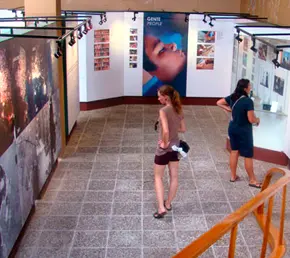
The Interpretation Centre gives a perfect explanation of this unique archipelago. Its exhibition helps you learn what makes this archipelago so unique. Information panels, pictures, documents, maquettes, and dioramas tell background and conservation stories about the islands.

Difficulty: Easy

archipel I san cristobal airport

Day 2: Santa Fe – South Plaza

AM – Santa Fe
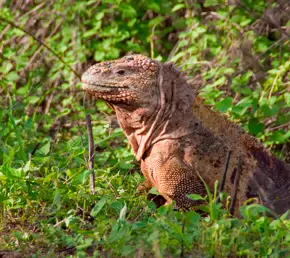
Located in the southeastern part of the Galapagos, this island was formed from an uplift instead of a volcanic origin, which is why it is mostly flat. Some theories assure this could be the oldest island in the archipelago. Santa Fe is the home of several endemic species like the Galapagos hawk, Galapagos snake, Galapagos mockingbird, rice rats and one of the two species of land iguanas of the islands. After disembarking in the beautiful and clear waters, you will be in contact with one of the many sea lion colonies. Along the trail, many salt bushes can be seen as well as giant prickly pear cactus, gigantism is a characteristic of oceanic islands.

PM – South Plaza
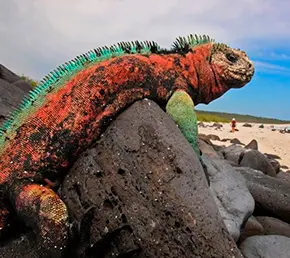
South Plaza is located to the east of Santa Cruz Island, and forms part of a pair of islands known as “Islas Plazas”. Despite its small size, some of the most interesting and outstanding species of the Galapagos are found here. The Plazas land iguanas are smaller than their relatives found on other islands. There are several hybrid iguanas throughout the island; a result of crossing a marine iguana with a land iguana. They are unique and recognizable at first glance by their black/grey colour, with a land iguana’s crest, but the face and tail of the marine iguana. The big population of iguanas is due to the presence of prickly pears, their favourite food. Swallow-tailed gulls nesting in the rugged cliffs are seen along with other sea birds as Audubon shearwaters, red-billed tropicbirds, frigate birds and brown pelicans.

Difficulty: Easy

archipel I santa fe

Day 3: North Seymour – Santiago

AM – North Seymour
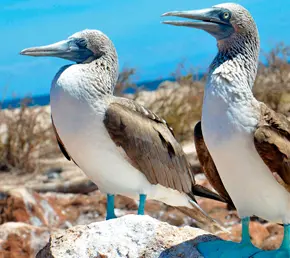
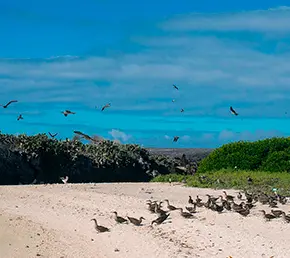
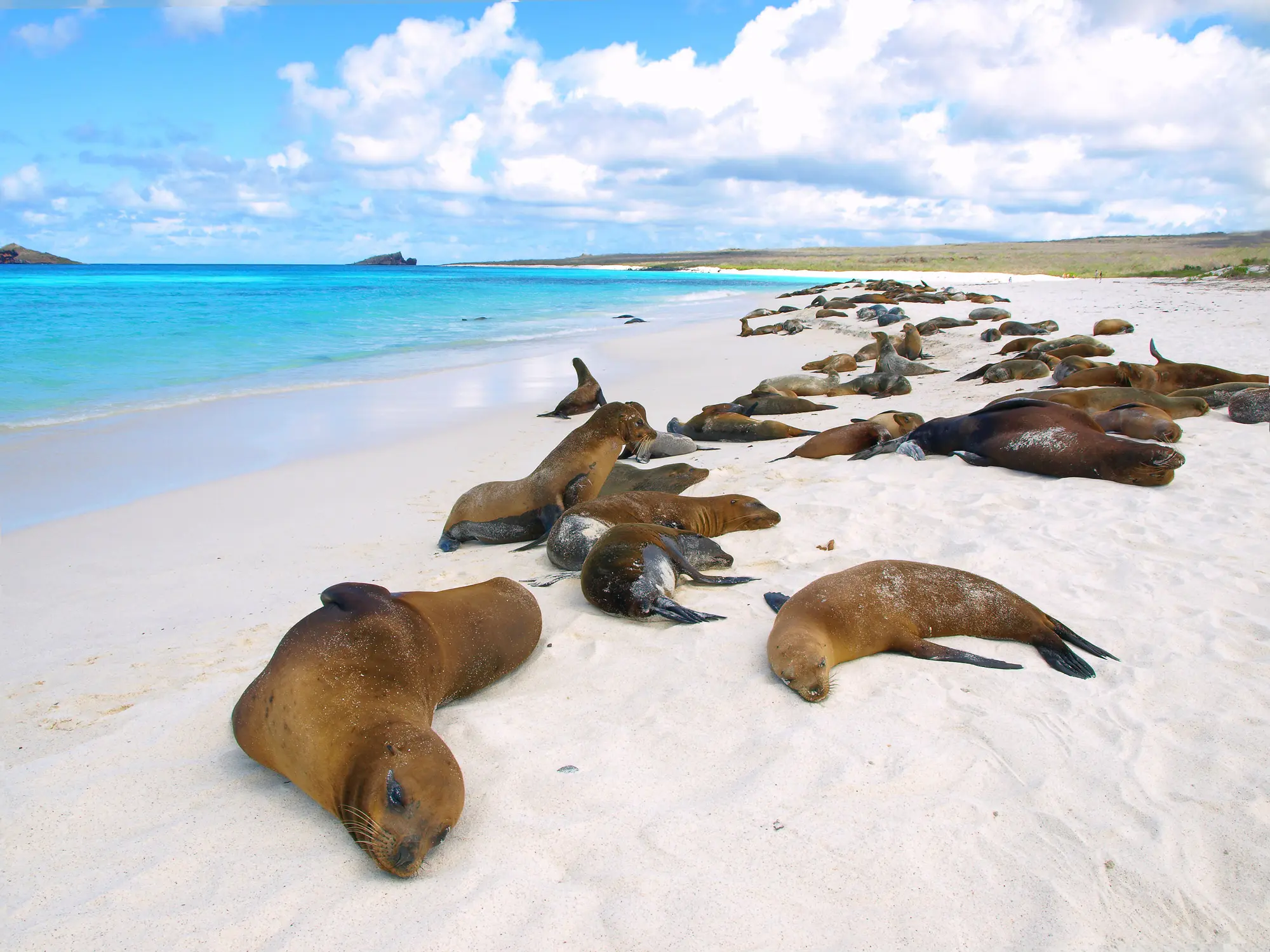
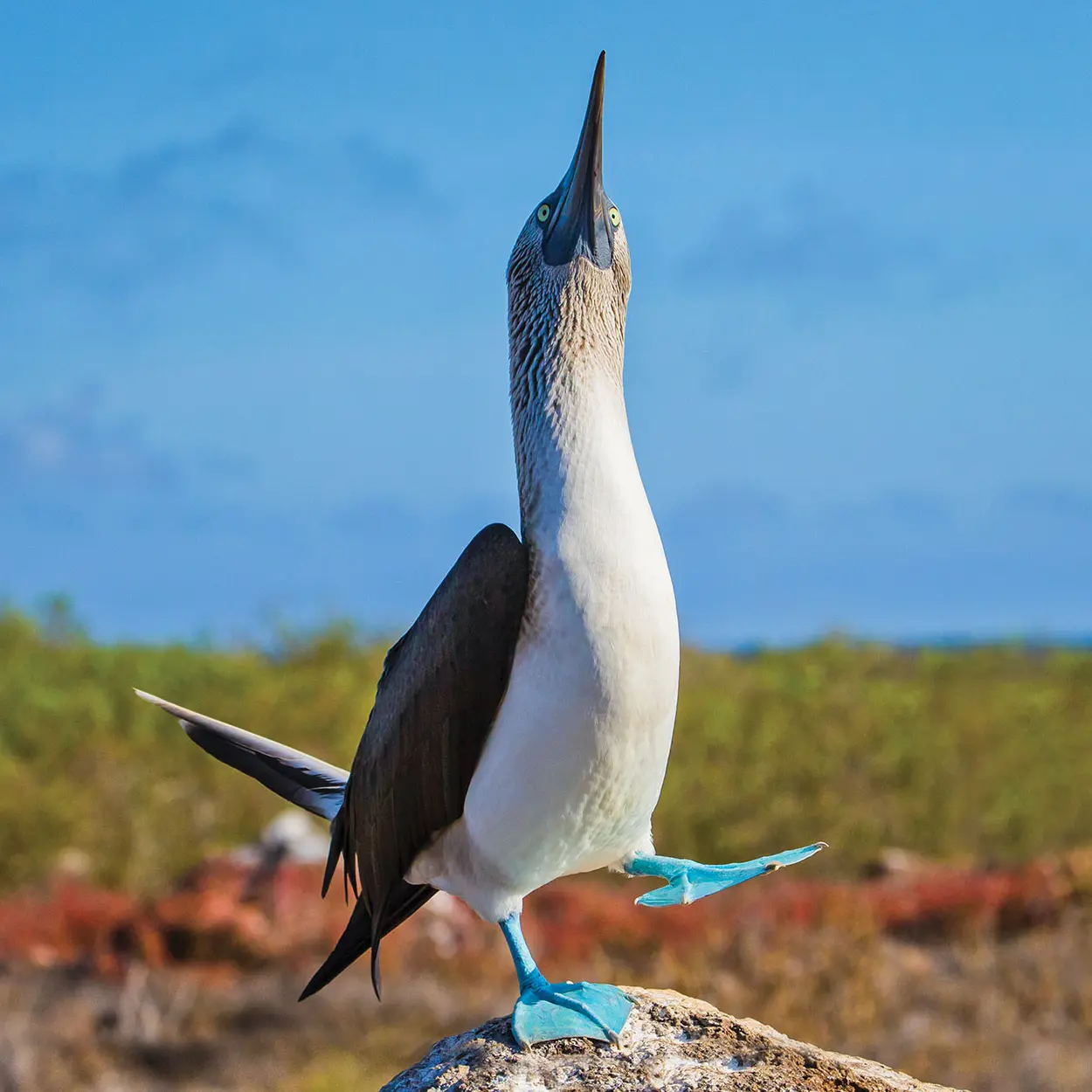
Seymour is an uplifted (as opposed to volcanic) island and therefore is generally flat and strewn with boulders. There are good nesting sites here for a large population of magnificent frigate birds. Blue-footed boobies perform their courtship dance in the more open areas and swallow-tailed gulls perch on the cliff edges. Despite the tremendous surf that can pound the outer shore, sea lions haul out onto the beach and can be found bodysurfing.

PM – Chinese Hat Chinese
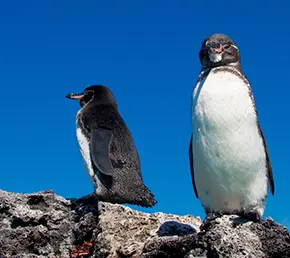
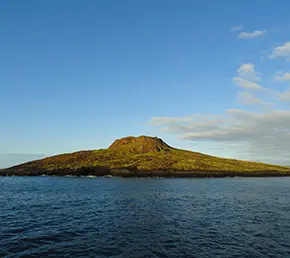
Hat is a 52 m/170 ft high volcanic cone, forming another islet right off the rocky coast of Santiago, where a small colony of Galapagos penguins have settled. Approaching Chinese Hat from the north, you will understand the meaning of the name. This is an excellent place to learn more about volcanoes, lava bombs and lava tunnels.

You will arrive just in time to witness how this barren islet is colonised by pioneer species that have begun to sprout! Beautiful beaches of white coral sand and holes in the eroding lava fields are filled up with lava sand, which enables rooting. Galapagos sea lions and countless marine iguanas contribute to fertilisation and thus create many favourable options for newcomers, such as saltbush and the sesuvium carpet.

Difficulty: Easy

archipel-I-seymour-norte

Day 4: Santa Cruz

AM – Twin Craters and El Chato Reserve (Santa Cruz)
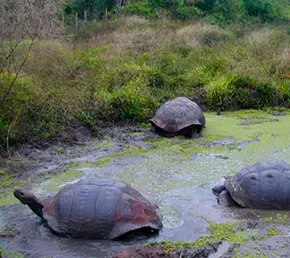
The native scalesia forest of El Chato Tortoise Reserve is the best place to search for Galapagos giant tortoises in their most authentic setting! Despite the interesting breeding centres – where you are guaranteed to find tortoises in their corrals – there is nothing better than to observe them in their wild environment. Though it can be quite moist and muddy, your visit may turn into an adventurous quest when they have left their favorite pond silently.

The Twin Craters are found on either side of the road leading to Puerto Ayora. These impressive formations are not really volcanic craters and were formed by magma domes, which hardened on the outside while the lava continued flowing inside, leaving huge and empty magma chambers that eventually collapsed, leaving two large holes. The craters lie within a lush scalesia cloud forest, a high-altitude plant species that are endemic to the Galapagos. This area is also home to the carpenter finch, which uses tools to search for food. There may also be opportunities to see the vermillion flycatcher, a small red-breasted bird.

PM – Fausto Llerena Breeding Centre (Santa Cruz)
At this site, you can observe tortoises that come from various islands of the archipelago. They comply with the captive breeding programme and then return to repopulate the areas where their population has been affected. The land iguanas of Santa Cruz, Isabela and North Seymour are also in a captive breeding programme, as the populations in these areas suffered from feral dogs.

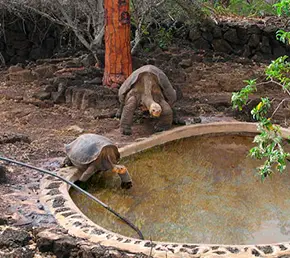
One of the main attractions is the famous embalmed Lonesome George. Estimated to have died between 93 and 109 years of age, it is recognised as the last of its kind and a symbol of the efforts invested to conserve endangered species. The captive tortoises are used to the presence of visitors, so it’s a great place to take photos with them.

Difficulty: Easy

archipel elChato

Day 5: Isabela

AM – Moreno Point (Isabela)
Moreno Point is located on the north coast of Isabela Island, between the volcanos Sierra Negra and Cerro Azul. The trail runs along a solidified pahoehoe lava flow into a complex of coastal lagoons. Its main attractions are several species of birds, which are found around the lakes and mangroves.

PM – Urbina Bay (Isabela)
Urbina Bay is located along the west coast of Isabela, between Elizabeth Bay and Tagus Cove. It is close to the base of the Alcedo Volcano. The coastline has undergone a major uplift in 1954, which caused the shore to expand three quar ters of a mile out. Here you will be able to find corals, shells, and many other calcareous organisms exposed above water. Urbina Bay is home to large and colorful land iguanas and giant tor toises of the Alcedo Volcano population. A lot of Darwin finches can be seen as well.

Difficulty: Easy

archipel-I-moreno_point

Day 6: Fernandina

AM – Espinoza Point (Fernandina)
Fernandina is the third-largest island in the archipelago and has a single visitor site: Punta Espinoza, located at the northeastern tip of the island. Marine iguanas conglomerate in larger groups than on any other island. They bask around in the sand, swim near the shore and sometimes block the way at the landing dock. Among the unique species found here, is the flightless cormorant. This bird had to adjust its way of survival and perfection its skills of finding food in the ocean. Their wings, tails and feet progressively adapted for swimming. To see these birds is to witness evolution happening right in front of you.

PM – Vicente Roca Point (Isabela)
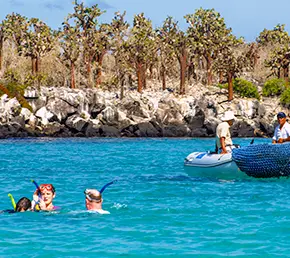
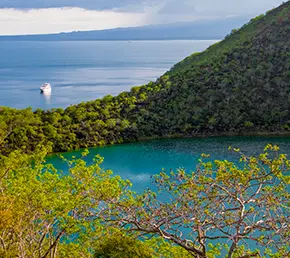
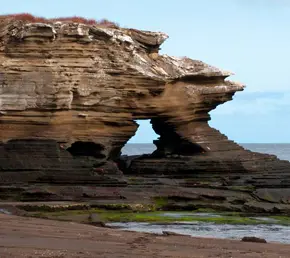
Whilst having lunch we will cross the Bolivar Channel for the last time to Vicente Roca Point, just at the mouth of Isabela’s seahorse-shape. While entering a dark cave below a spectacular arch, roaring echoes of the waves will accompany you. Just around the corner the collapsed amphitheatre of Volcan Ecuador offers another impressive view. The calmer waters of the coves are well-protected against the ocean swell and are a fairly cold, but great place for snorkelling amongst various species of shark, penguins, puffer fish and even seahorses!

Difficulty: Easy – Moderated

archipel-espinoza_point

Day 7: Santiago - Rábida

AM – Egas Port (Santiago)
Puerto Egas is a black beach located on the west side of Santiago Island. Volcanic tuff deposits have favoured the formation of this special black sand beach and this is the main attraction of the Island. This site is called Puerto Egas because there was an attempt of Hector Egas to start the exploitation of salt, which failed. After all, the price of salt on the continent was very cheap and did not justify its exploitation in the Galapagos. The project was abandoned and they left their infrastructure.

PM – Rábida
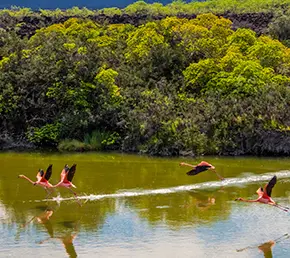
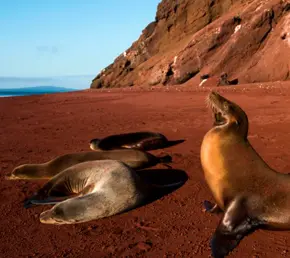
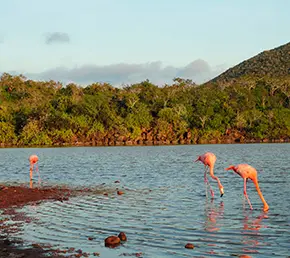
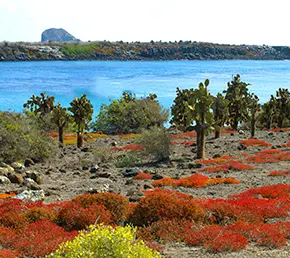
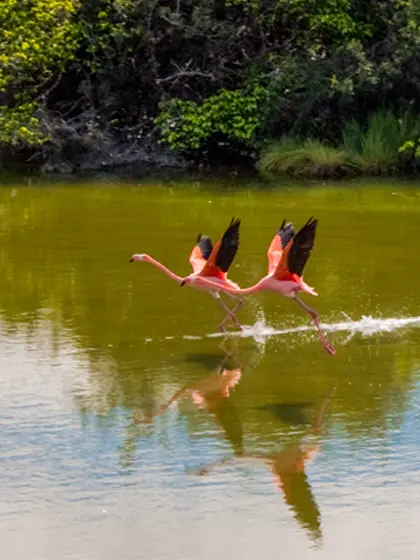
Rábida Island is unique because of the red colour of the rocks and sand. The volcanic material in this island is very porous and external factors such as rain, saltwater and sea breeze have acted as an oxidizing agent. A short walk along a trail will lead you to a coastal lagoon behind the beach that allows for the observation of land birds as finches, doves, yellow warblers and mockingbirds. There is also a colony of flamingos at the lagoon.

Difficulty: Easy – Moderated

archipel-rabida

Day 8: Santa Cruz - Baltra

AM – Black Turtle Cove (Santa Cruz)
After breakfast, you will check out and disembark the cruise for the last time at 08:30 am.

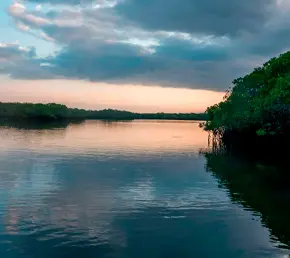
Your last adventure is brief but enchanting, and will take place enroute to the airport. You will explore onboard the dinghy the green landscape of Black Turtle Cove, which is mostly composed of mangrove trees that host innumerable aerial and aquatic species. Observe how the quiet emerald lagoon and surrounding shallow bays enables the easy observation of sea turtles and as well as groups of sharks.

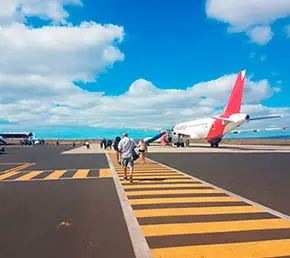
The visit ends and you will disembark at 09:00 at Baltra island, ultimately reaching Baltra airport at 09:30, where its the official end of your cruise adventure.

It has been a pleasure accompanying you on this unique trip and we hope to see you again very soon!

archipel-baltra-airport

Itinerary B 8D/7N

Day 1: Baltra

AM – Arrival at Baltra airport
Upon arrival at Baltra airport, you will pass through an airport inspection point to ensure that no foreign plants or animals are introduced to the islands, as well as to pay the park entrance fee of $200 (unless it has been prepaid). A guide will meet you, help you collect your luggage, and escort you on a short bus ride to the harbour.

PM – Bachas (Santa Cruz)
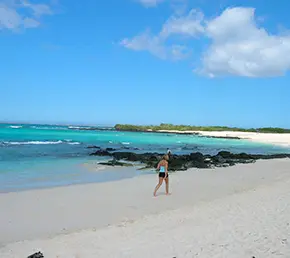
These two small beaches are located in the west of the Turtle Cove on Santa Cruz. Their sand consists of decomposed corals, which makes it white and soft. This makes it the favorite nesting site for sea turtles. Behind one of the beaches there are small water lagoons, where flamingos and other coastal birds, such as black-necked stilt birds and rainbows, can occasionally be spotted. On the second beach, which is the wider one, you can explore the remains of two abandoned warships. In the Second World War these were left by the US, as the island of Baltra was used as a strategic point for the protection of the Panama Canal.

Difficulty: Easy

archipel-bachas_beach

Day 2: Genovesa

AM – Prince Philip’s Steps (Genovesa)
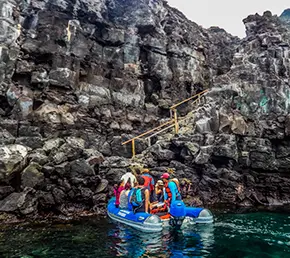
Before landing, you will take a dinghy ride along the eastern arm of the caldera. As you approach, the soaring 25 m/80 ft high walls become overwhelming. Sometimes, a Galapagos fur seal is resting or a seabird is nesting on one of the ledges at the base. You will then have to hike and overcome the steep stairs from the landing dock to a bush of palo santo shrubs on top. Red-footed boobies gratefully use these scarce nesting places; so that they don’t have to nest on the rocky ground. Upon arriving at the edge of the rim, the bushes open up and you can enjoy panoramic views, a strong sea breeze and the amazing flying skills of countless seabirds. Following the exposed rim, you will first pass the Nazca boobies and finally reach the extensive storm petrel nesting places, where, if you’re lucky, you can spot the well-camouflaged short-eared owl hunting for food!

PM – Darwin Bay (Genovesa)
Inside the submerged caldera of Genovesa lies Darwin Bay, with a diameter of more than 1.5 km/1 mi and it is almost 200 m/650 ft deep. The small area will surprise you repeatedly, walking along a coral sand beach, crossing barren lava formations and creeks, passing tidal pools, shrubs and further ahead following the top of some cliffs. With this peaceful surroundings, every single species has occupied its own ecological niche (or habitat) without disturbing others.

Difficulty: Easy

archipel-prince-philips-steps

Day 3: Bartholomew – Santiago

AM – Bartholomew
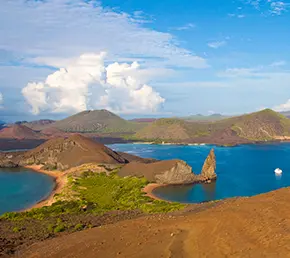
The beautiful volcanic islet of Bartholomew is among the youngest of the islands and, on a geological scale, was just recently born out of the fire. Although it looks lifeless at first sight, Bartholomew offers some of the wildest landscapes and best panoramas of the entire archipelago. To enjoy the postcard view of the idyllic “Pinnacle Bay” you will have to climb the stairs to the viewpoint on top of the island (114 m/375 ft). Enter a dramatic world of threatening (though extinguished) nearby spatter cones, craters, and lightweight lava droplets that have been spewed out by fiery fountains. The summit trail is also ideal for witnessing how scanty pioneer vegetation, such as lava cactus, struggles to take root in the bare virgin lava fields.

PM – Sullivan Bay (Santiago)
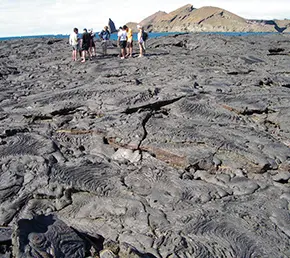
The arrival in Sullivan Bay is like a moon landing. The desolate, sprawling fields seem to be mostly lifeless, but this island, which is particularly popular among photographers, still offers a lot to see. There is even some life! Green sea turtles burrow in the small white sand beach, where you can also find crabs, blue herons and oystercatchers.

Difficulty: Easy

archipel-sullivan_bay

Day 4: Santa Cruz

AM – Twin Craters and El Chato Reserve (Santa Cruz)
The native scalesia forest of El Chato Tortoise Reserve is the best place to search for Galapagos giant tortoises in their most authentic setting! Despite the interesting breeding centres – where you are guaranteed to find tortoises in their corrals – there is nothing better than to observe them in their wild environment. Though it can be quite moist and muddy, your visit may turn into an adventurous quest when they have left their favourite pond silently.

The Twin Craters are found on either side of the road leading to Puerto Ayora. These impressive formations are not really volcanic craters and were formed by magma domes, which hardened on the outside while the lava continued flowing inside, leaving huge and empty magma chambers that eventually collapsed, leaving two large holes. The craters lie within a lush scalesia cloud forest, a high-altitude plant species that are endemic to the Galapagos. This area is also home to the carpenter finch, which uses tools to search for food. There may also be opportunities to see the vermillion flycatcher, a small red-breasted bird.

PM – Fausto Llerena Breeding Centre (Santa Cruz)
At this site, you can observe tortoises that come from various islands of the archipelago. They comply with the captive breeding programme and then return to repopulate the areas where their population has been affected. The land iguanas of Santa Cruz, Isabela and North Seymour are also in a captive breeding programme, as the populations in these areas suffered from feral dogs.

One of the main attractions is the famous embalmed Lonesome George. Estimated to have died between 93 and 109 years of age, it is recognised as the last of its kind and a symbol of the efforts invested to conserve endangered species. The captive tortoises are used to the presence of visitors, so it’s a great place to take photos with them.

Difficulty: Easy

Archipel I Fausto Llerena Breeding Centre

Day 5: Floreana

AM – Cormorant Point and Devil’s Crown (Floreana)
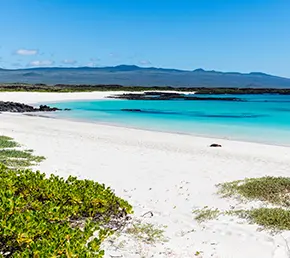
The peninsula of Cormorant Point forms the extreme north cape of Floreana, which exists out of smaller volcanic cones, covered by a tropical dry forest of palo santo. At the landing beach, you will be welcomed by a small Galapagos sea lion colony. The green sand on this beach contains a high percentage of glassy olivine crystals which have been blown out by the surrounding tuff cones. The “flour sand” beach on the southern side of the peninsula is made up of even finer white coral sand which feels very smooth on the feet. Parrotfish have pulverised it, grinding the calcareous skeletons of living coral. You can spot schools of stingrays who love the sandy bottom to hide. During the first months of the year, Pacific green turtles come ashore to bury their eggs.

Devil’s Crown offers one of the best snorkelling spots in the Galapagos due to the coral reef in its centre, which attracts a lot of marine life. Here you can spot Galapagos penguins, sea lions, sea turtles, many different colourful fish and even some dolphins. The current can be a bit strong sometimes, so it should not be attempted by novice swimmers.

PM – Post Office Bay and Baroness Lookout (Floreana)
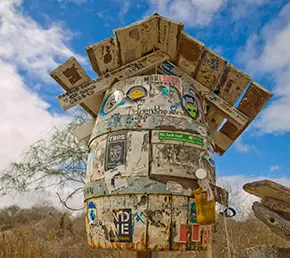
Historically, this site is the location of a wooden barrel that was placed there in the 18th century by the crew of a whaling ship. Letters found inside the barrel were collected and delivered by sailors returning home. There was no postage fee and, surprisingly, this mailbox and its honour system are still in use today. Although letters are no longer important messages from sailors to their loved ones, tourists leave thousands of them today and many still reach their destination. You can also relax on the beach, where in addition to Galapagos sea lions, Pacific green turtles and golden rays, you may see Galapagos penguins. This is the only place in the southeastern archipelago where penguins reside. You can also climb the small basaltic cone of the Baroness Lookout, and enjoy the paradisiacal views of the coastline. This viewpoint was the favourite spot of one of Floreana’s first settlers, the eccentric baroness and self-proclaimed “Empress of Galapagos” Eloisa von Wagner, who even built her house a few metres further back.

Difficulty: Easy – Moderate
archipel-post_office_baywebp

Day 6: Española

AM – Osborn Islet and Gardner Bay (Española)
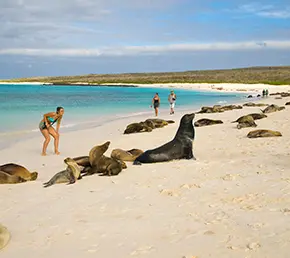
The striking white beach at Gardner Bay is an important breeding site for Pacific green turtles. However, without a doubt, its main attraction is the Galapagos sea lion colony. Females stay year-round in this nursery, suckling their pups until they are three years old, although they start to fish at five months. During the breeding and mating season, the colony becomes even bigger.

PM – Suarez Point (Española)
Huge ocean waves crash onto the southern basaltic cliffs of Suarez Point, forming a spectacular blowhole, where the water sprays metres high into the air (depending on the season, the tide and how strongly the sea breeze pushes the waves). Take your time for a meditative break in silence on this emblematic viewpoint, and convert this unforgettable moment into a lifetime experience.

Difficulty: Moderated – Easy

archipel-suarez_point

Day 7: San Cristobal

AM – Pitt Point (San Cristobal)
Two wind-sculptured tuff cones at Pitt Point make up the extreme eastern end of San Cristobal, and thus, the archipelago as well. These cliffs were the first sight of land when HMS Beagle and Charles Darwin arrived on the 15th of September, 1835. On the small green sand beach, you will be welcomed by a group of barking Galapagos sea lions. This is a bachelor colony, where males usually relax and prepare themselves for fighting and mating.

PM – Witch Hill (San Cristobal)
The primary attraction of this site is the coral sand beach, an excellent place to swim and snorkel. Witch Hill is the remains of a tuff cone and one of the first sites visited by Charles Darwin. It has an impressive landscape, where it is often possible to see coastal and migratory birds, including pelicans, blue-footed boobies and swallow-tailed gulls; as well as sea lions and marine iguanas. At times, the lagoon is completely dry and deposits of salt can be found at the bottom. The people of Puerto Baquerizo Moreno used to use the lagoon as a salt mine.

Difficulty: Easy – Moderated

archipel-cerro_brujo

Day 8: San Cristobal

AM – Lobos Islet (San Cristobal)
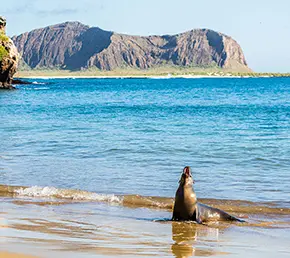
The Lobos Islet’s beach harbours a colony of Galapagos sea lions. As in other colonies in the archipelago, you can approach nurturing females within a few metres. In the breeding season, this colony is also visited by territorial males, defending and mating the harem on their part of the beach. This low islet is home to more than just Galapagos sea lions. Two other emblematic species breed here: male blue-footed boobies and great frigate birds who try to impress the females (and tourists) with clumsy dances, heaving their striking blue feet or blowing up their balloon-sized scarlet pouches. During the breeding season, the fluffy and hungry chicks cry for food, and when their wings get strong enough, they will learn to fly.

After this, assisted by the naturalist guide and some crew members, you will be taken to San Cristobal airport. It has been a pleasure accompanying you on this unique trip and we hope to see you again very soon!

Difficulty: Easy

archipel-lobos_islet

Itinerary A5B4 8D/7N

Day 1: Baltra - Santa Cruz

AM – Arrival at Baltra airport
Upon arrival at Baltra airport, you will pass through an airport inspection point to insure that no foreign plants or animals are introduced to the islands, as well as to pay the park entrance fee of $200 (unless it has been prepaid). A guide will meet you, help you collect your luggage, and escort you on a short bus ride to the harbour.

PM – Fausto Llerena Breeding Centre (Santa Cruz)
At this site, you can observe tortoises that come from various islands of the archipelago. They comply with the captive breeding programme and then return to repopulate the areas where their population has been affected. The land iguanas of Santa Cruz, Isabela and North Seymour are also in a captive breeding programme, as the populations in these areas suffered from feral dogs. One of the main attractions is the famous embalmed Lonesome George. Estimated to have died between 93 and 109 years of age, it is recognised as the last of its kind and a symbol of the efforts invested to conserve endangered species. The captive tortoises are used to the presence of visitors, so it’s a great place to take photos with them.

Difficulty: Easy

Archipel I Fausto Llerena Breeding Centre

Day 2: Isabela

AM – Moreno Point (Isabela)
Moreno Point is located on the north coast of Isabela Island, between the volcanos Sierra Negra and Cerro Azul. The trail runs along a solidified pahoehoe lava flow into a complex of coastal lagoons. Its main attractions are several species of birds, which are found around the lakes and mangroves.

PM – Urbina Bay (Isabela)
Urbina Bay is located along the west coast of Isabela, between Elizabeth Bay and Tagus Cove. It is close to the base of the Alcedo Volcano. The coastline has undergone a major uplift in 1954, which caused the shore to expand three quar ters of a mile out. Here you will be able to find corals, shells, and many other calcareous organisms exposed above water. Urbina Bay is home to large and colorful land iguanas and giant tor toises of the Alcedo Volcano population. A lot of Darwin finches can be seen as well.

Difficulty: Moderated – Easy

archipel-urbina-bay

Day 3: Fernandina - Isabela

AM – Espinoza Point (Fernandina)
Fernandina is the third-largest island in the archipelago and has a single visitor site: Punta Espinoza, located at the northeastern tip of the island. Marine iguanas conglomerate in larger groups than on any other island. They bask around in the sand, swim near the shore and sometimes block the way at the landing dock. Among the unique species found here, is the flightless cormorant. This bird had to adjust its way of survival and perfection its skills of finding food in the ocean. Their wings, tails and feet progressively adapted for swimming. To see these birds is to witness evolution happening right in front of you.

PM – Vicente Roca Point (Isabela)
Whilst having lunch we will cross the Bolivar Channel for the last time to Vicente Roca Point, just at the mouth of Isabela’s seahorse-shape. While entering a dark cave below a spectacular arch, roaring echoes of the waves will accompany you. Just around the corner the collapsed amphitheatre of Volcan Ecuador offers another impressive view. The calmer waters of the coves are well-protected against the ocean swell and are a fairly cold, but great place for snorkelling amongst various species of shark, penguins, puffer fish and even seahorses!

Difficulty: Easy – Moderated

archipel-tagus_cove

Day 4: Santiago - Rabida

AM – Egas Port (Santiago)
Egas Port is a black beach located on the west side of Santiago Island. Volcanic tuff deposits have favoured the formation of this special black sand beach and this is the main attraction of the Island. This site is called Puerto Egas because there was an attempt of Hector Egas to start the exploitation of salt, which failed. After all, the price of salt on the continent was very cheap and did not justify its exploitation in the Galapagos. The project was abandoned and they left their infrastructure.

PM – Rabida
Rabida Island is unique because of the red colour of the rocks and sand. The volcanic material in this island is very porous and external factors such as rain, saltwater and sea breeze have acted as an oxidizing agent. A short walk along a trail will lead you to a coastal lagoon behind the beach that allows for the observation of land birds as finches, doves, yellow warblers and mockingbirds. There is also a colony of flamingos at the lagoon.

Difficulty: Easy – Moderated

archipel-puerto-egas

Day 5: Santa Cruz

AM – Black Turtle Cove (Santa Cruz)
After breakfast, you will check out and disembark the cruise for the last time at 08:30 am.

Your last adventure is brief but enchanting, and will take place enroute to the airport. You will explore onboard the dinghy the green landscape of Black Turtle Cove, which is mostly composed of mangrove trees that host innumerable aerial and aquatic species. Observe how the quiet emerald lagoon and surrounding shallow bays enables the easy observation of sea turtles and as well as groups of sharks.

PM – Bachas Beach (Santa Cruz)
Around noon you will embark from Baltra airport on the Archipel cruise. Your cabins will be assigned, and lunch will be promptly served. Your first excursion will take place this afternoon after 14:00 PM, at Bachas beach. This is a lovely bay with soft, white coral sand that is frequently visited by sea turtles to lay their eggs, so please, watch your step! After enjoying some leisure time at the beach, you could explore a small lagoon hidden behind some bushes, where occasionally it is possible to observe flamingos, black-necked stilts, and whimbrels. You might also observe some rusty barges, which were abandoned here after WWII when the USA rented this island as a strategic point to protect the Panama Channel from Japan. After two hours on this visit, you will return onboard.

Difficulty: Easy

archipel-caleta-tortuga-negra

Day 6: Genovesa

AM – Prince Philip’s Steps (Genovesa)
Before landing, you will take a dinghy ride along the eastern arm of the caldera. As you approach, the soaring 25 m/80 ft high walls become overwhelming. Sometimes, a Galapagos fur seal is resting or a seabird is nesting on one of the ledges at the base. You will then have to hike and overcome the steep stairs from the landing dock to a bush of palo santo shrubs on top. Red-footed boobies gratefully use these scarce nesting places; so that they don’t have to nest on the rocky ground. Upon arriving at the edge of the rim, the bushes open up and you can enjoy panoramic views, a strong sea breeze and the amazing flying skills of countless seabirds. Following the exposed rim, you will first pass the Nazca boobies and finally reach the extensive storm petrel nesting places, where, if you’re lucky, you can spot the well-camouflaged short-eared owl hunting for food!

PM – Darwin Bay (Genovesa)
Inside the submerged caldera of Genovesa lies Darwin Bay, with a diameter of more than 1.5 km/1 mi and it is almost 200 m/650 ft deep. The small area will surprise you repeatedly, walking along a coral sand beach, crossing barren lava formations and creeks, passing tidal pools, shrubs and further ahead following the top of some cliffs. With this peaceful surroundings, every single species has occupied its own ecological niche (or habitat) without disturbing others.

Difficulty: Easy

archipel-darwi_bay

Day 7: Bartholomew – Santiago

AM – Bartholomew
The beautiful volcanic islet of Bartholomew is among the youngest of the islands and, on a geological scale, was just recently born out of the fire. Although it looks lifeless at first sight, Bartholomew offers some of the wildest landscapes and best panoramas of the entire archipelago. To enjoy the postcard view of the idyllic “Pinnacle Bay” you will have to climb the stairs to the viewpoint on top of the island (114 m/375 ft). Enter a dramatic world of threatening (though extinguished) nearby spatter cones, craters, and lightweight lava droplets that have been spewed out by fiery fountains. The summit trail is also ideal for witnessing how scanty pioneer vegetation, such as lava cactus, struggles to take root in the bare virgin lava fields.

PM – Sullivan Bay (Santiago)
The arrival in Sullivan Bay is like a moon landing. The desolate, sprawling fields seem to be mostly lifeless, but this island, which is particularly popular among photographers, still offers a lot to see. There is even some life! Green sea turtles burrow in the small white sand beach, where you can also find crabs, blue herons and oystercatchers.

Difficulty: Easy

archipel-bartolome

Day 8: Santa Cruz - Baltra

AM – Twin Craters and El Chato Reserve (Santa Cruz)
The native scalesia forest of El Chato Tortoise Reserve is the best place to search for Galapagos giant tortoises in their most authentic setting! Despite the interesting breeding centres – where you are guaranteed to find tortoises in their corrals – there is nothing better than to observe them in their wild environment. Though it can be quite moist and muddy, your visit may turn into an adventurous quest when they have left their favourite pond silently.

The Twin Craters are found on either side of the road leading to Puerto Ayora. These impressive formations are not really volcanic craters and were formed by magma domes, which hardened on the outside while the lava continued flowing inside, leaving huge and empty magma chambers that eventually collapsed, leaving two large holes. The craters lie within a lush scalesia cloud forest, a high-altitude plant species that are endemic to the Galapagos. This area is also home to the carpenter finch, which uses tools to search for food. There may also be opportunities to see the vermillion flycatcher, a small red-breasted bird.

After this, assisted by the naturalist guide and some crew members, you will be taken to Baltra airport. It has been a pleasure accompanying you on this unique trip and we hope to see you again very soon!

Difficulty: Easy

archipel elChato

Itinerary B5A4 8D/7N

Day 1: Baltra - Santa Cruz

AM – Arrival at Baltra airport
Upon arrival at San Cristobal airport, you will pass through an airport inspection point to ensure that no foreign plants or animals are introduced to the islands, as well as to pay the park entrance fee of $100 (unless it has been prepaid). A guide will meet you, help you collect your luggage, and escort you on a short bus ride to the harbour.

PM – Fausto Llerena Breeding Centre (Santa Cruz)
At this site, you can observe tortoises that come from various islands of the archipelago. They comply with the captive breeding programme and then return to repopulate the areas where their population has been affected. The land iguanas of Santa Cruz, Isabela and North Seymour are also in a captive breeding programme, as the populations in these areas suffered from feral dogs. One of the main attractions is the famous embalmed Lonesome George. Estimated to have died between 93 and 109 years of age, it is recognised as the last of its kind and a symbol of the efforts invested to conserve endangered species. The captive tortoises are used to the presence of visitors, so it’s a great place to take photos with them.

Archipel I Fausto Llerena Breeding Centre

Day 2: Floreana

AM – Cormorant Point and Devil’s Crown (Floreana)
The peninsula of Cormorant Point forms the extreme north cape of Floreana, which exists out of smaller volcanic cones, covered by a tropical dry forest of palo santo. At the landing beach, you will be welcomed by a small Galapagos sea lion colony. The green sand on this beach contains a high percentage of glassy olivine crystals which have been blown out by the surrounding tuff cones. The “flour sand” beach on the southern side of the peninsula is made up of even finer white coral sand which feels very smooth on the feet. Parrotfish have pulverised it, grinding the calcareous skeletons of living coral. You can spot schools of stingrays who love the sandy bottom to hide. During the first months of the year, Pacific green turtles come ashore to bury their eggs.

Devil’s Crown offers one of the best snorkelling spots in the Galapagos due to the coral reef in its centre, which attracts a lot of marine life. Here you can spot Galapagos penguins, sea lions, sea turtles, many different colourful fish and even some dolphins. The current can be a bit strong sometimes, so it should not be attempted by novice swimmers.

PM – Post Office Bay and Baroness Lookout (Floreana)
Historically, this site is the location of a wooden barrel that was placed there in the 18th century by the crew of a whaling ship. Letters found inside the barrel were collected and delivered by sailors returning home. There was no postage fee and, surprisingly, this mailbox and its honour system are still in use today. Although letters are no longer important messages from sailors to their loved ones, tourists leave thousands of them today and many still reach their destination. You can also relax on the beach, where in addition to Galapagos sea lions, Pacific green turtles and golden rays, you may see Galapagos penguins. This is the only place in the southeastern archipelago where penguins reside. You can also climb the small basaltic cone of the Baroness Lookout and enjoy the coastline’s paradisiacal views. This viewpoint was the favourite spot of one of Floreana’s first settlers, the eccentric baroness and self-proclaimed “Empress of Galapagos” Eloisa von Wagner, who even built her house a few metres further back.

Difficulty: Easy – Moderate
archipel-cormorant_point

Day 3: Española

AM – Osborn Islet and Gardner Bay (Española)
The striking white beach at Gardner Bay is an important breeding site for Pacific green turtles. However, without a doubt, its main attraction is the Galapagos sea lion colony. Females stay year-round in this nursery, suckling their pups until they are three years old, although they start to fish at five months. During the breeding and mating season, the colony becomes even bigger.

PM – Suarez Point (Española)
Huge ocean waves crash onto the southern basaltic cliffs of Suarez Point, forming a spectacular blowhole, where the water sprays metres high into the air (depending on the season, the tide and how strongly the sea breeze pushes the waves). Take your time for a meditative break in silence on this emblematic viewpoint, and convert this unforgettable moment into a lifetime experience.

Difficulty: Moderated – Easy

archipel-gardner_bay

Day 4: San Cristobal

AM – Pitt Point
Two wind-sculptured tuff cones at Pitt Point make up the extreme eastern end of San Cristobal, thus the archipelago. These cliffs were the first sight of land when HMS Beagle and Charles Darwin arrived on the 15th of September, 1835. On the small green sand beach, you will be welcomed by a group of barking Galapagos sea lions. This is a bachelor colony, where males usually relax and prepare themselves for fighting and mating.

PM – Witch Hill
This site’s primary attraction is the coral sand beach, an excellent place to swim and snorkel. Witch Hill is the remains of a tuff cone and one of the first sites visited by Charles Darwin. It has an impressive landscape, where it is often possible to see coastal and migratory birds, including pelicans, blue-footed boobies and swallow-tailed gulls; as well as sea lions and marine iguanas. At times, the lagoon is completely dry and deposits of salt can be found at the bottom. The people of Puerto Baquerizo Moreno used to use the lagoon as a salt mine.

Difficulty: Easy – Moderated

archipel-pitt_point

Day 5: San Cristobal

AM – Lobos Islet
The Lobos Islet’s beach harbours a colony of Galapagos sea lions. As in other colonies in the archipelago, you can approach nurturing females within a few metres. In the breeding season, this colony is also visited by territorial males, defending and mating the harem on their part of the beach. This low islet is home to more than just Galapagos sea lions. Two other emblematic species breed here: male blue-footed boobies and great frigate birds who try to impress the females (and tourists) with clumsy dances, heaving their striking blue feet or blowing up their balloon-sized scarlet pouches. During the breeding season, the fluffy and hungry chicks cry for food, and when their wings get strong enough, they will learn to fly.

PM – Interpretation Centre and Frigatebird Hill (San Cristobal)
The Interpretation Centre, just outside the provincial capital city of Puerto Baquerizo Moreno, gives a perfect explanation of this unique archipelago. Its attractive exhibition is quite complete and helps you to get a clear overview and learn what makes this archipelago so unique. Information panels (in English and Spanish), pictures, documents, maquettes, and true-to-life dioramas tell various background and conservation stories about the islands in a different way.

A short, though often hot, uphill trail with steps, leads from the Interpretation Centre to the summit of Frigatebird Hill. Four panoramic viewpoints show Puerto Baquerizo Moreno from above, as well as the bays on both sides of the headland. On clear days even the distant, offshore sculpture of Kicker Rock can be seen! These wooded hilltops are one of the rare places where some magnificent and great frigatebirds form a mixed breeding colony. A viewpoint with another Charles Darwin statue is a reminder that the HMS Beagle anchored in the exotic bay below.

Difficulty: Easy

archipel-interpretation-center

Day 6: Santa Fe – South Plaza

AM – Santa Fe
Located in the southeastern part of the Galapagos, this island was formed from an uplift instead of a volcanic origin, which is why it is mostly flat. Some theories assure this could be the oldest island in the archipelago. Santa Fe is the home of several endemic species like the Galapagos hawk, Galapagos snake, Galapagos mockingbird, rice rats and one of the two species of land iguanas of the islands. After disembarking in the beautiful and clear waters, you will be in contact with one of the many sea lion colonies. Along the trail, many salt bushes can be seen as well as giant prickly pear cactus, gigantism is a characteristic of oceanic islands.

PM – South Plaza
South Plaza is located to the east of Santa Cruz Island, and forms part of a pair of islands known as “Islas Plazas”. Despite its small size, some of the most interesting and outstanding species of the Galapagos are found here. The Plazas land iguanas are smaller than their relatives found on other islands. There are several hybrid iguanas throughout the island; a result of crossing a marine iguana with a land iguana. They are unique and recognizable at first glance by their black/grey colour, with a land iguana’s crest, but the face and tail of the marine iguana. The big population of iguanas is due to the presence of prickly pears, their favourite food. Swallow-tailed gulls nesting in the rugged cliffs are seen along with other sea birds as Audubon shearwaters, red-billed tropicbirds, frigate birds and brown pelicans.

Difficulty: Easy

archipel-south-plaza

Day 7: North Seymour

AM – North Seymour
Seymour is an uplifted (as opposed to volcanic) island and therefore is generally flat and strewn with boulders. There are good nesting sites here for a large population of magnificent frigate birds. Blue-footed boobies perform their courtship dance in the more open areas and swallow-tailed gulls perch on the cliff edges. Despite the tremendous surf that can pound the outer shore, sea lions haul out onto the beach and can be found bodysurfing.

PM – Chinese Hat
Chinese Hat is a 52 m/170 ft high volcanic cone, forming another islet right off the rocky coast of Santiago, where a small colony of Galapagos penguins have settled. Approaching Chinese Hat from the north, you will understand the meaning of the name. This is an excellent place to learn more about volcanoes, lava bombs and lava tunnels. You will arrive just in time to witness how this barren islet is colonised by pioneer species that have begun to sprout! Beautiful beaches of white coral sand and holes in the eroding lava fields are filled up with lava sand, which enables rooting. Galapagos sea lions and countless marine iguanas contribute to fertilisation and thus create many favourable options for newcomers, such as saltbush and the sesuvium carpet.

Difficulty: Easy

archipel-chinese_hat

Day 8: Santa Cruz - Baltra

AM – Twin Craters and El Chato Reserve (Santa Cruz)
The native scalesia forest of El Chato Tortoise Reserve is the best place to search for Galapagos giant tortoises in their most authentic setting! Despite the interesting breeding centres – where you are guaranteed to find tortoises in their corrals – there is nothing better than to observe them in their wild environment. Though it can be quite moist and muddy, your visit may turn into an adventurous quest when they have left their favorite pond silently.

The Twin Craters are found on either side of the road leading to Puerto Ayora. These impressive formations are not really volcanic craters and were formed by magma domes, which hardened on the outside while the lava continued flowing inside, leaving huge and empty magma chambers that eventually collapsed, leaving two large holes. The craters lie within a lush scalesia cloud forest, a high-altitude plant species that are endemic to the Galapagos. This area is also home to the carpenter finch, which uses tools to search for food. There may also be opportunities to see the vermillion flycatcher, a small red-breasted bird.

After this, assisted by the naturalist guide and some crew members, you will be taken to the airport for your flight to Quito or Guayaquil. It has been a pleasure accompanying you on this unique trip and we hope to see you again very soon!

archipel-baltra-airport

Itinerary A5 5D/4N

Day 1: Baltra - Santa Cruz

AM – Arrival at Baltra airport
Upon arrival at Baltra airport, you will pass through an airport inspection point to insure that no foreign plants or animals are introduced to the islands, as well as to pay the park entrance fee of $200 (unless it has been prepaid). A guide will meet you, help you collect your luggage, and escort you on a short bus ride to the harbour.

PM – Fausto Llerena Breeding Centre (Santa Cruz)
At this site, you can observe tortoises that come from various islands of the archipelago. They comply with the captive breeding programme and then return to repopulate the areas where their population has been affected. The land iguanas of Santa Cruz, Isabela and North Seymour are also in a captive breeding programme, as the populations in these areas suffered from feral dogs.

One of the main attractions is the famous embalmed Lonesome George. Estimated to have died between 93 and 109 years of age, it is recognised as the last of its kind and a symbol of the efforts invested to conserve endangered species. The captive tortoises are used to the presence of visitors, so it’s a great place to take photos with them.

Difficulty: Easy

Archipel I Fausto Llerena Breeding Centre

Day 2: Isabela

AM – Moreno Point (Isabela)
Moreno Point is located on the north coast of Isabela Island, between the volcanos Sierra Negra and Cerro Azul. The trail runs along a solidified pahoehoe lava flow into a complex of coastal lagoons. Its main attractions are several species of birds, which are found around the lakes and mangroves.

PM – Urbina Bay (Isabela)
Urbina Bay is located along the west coast of Isabela, between Elizabeth Bay and Tagus Cove. It is close to the base of the Alcedo Volcano. The coastline has undergone a major uplift in 1954, which caused the shore to expand three quar ters of a mile out. Here you will be able to find corals, shells, and many other calcareous organisms exposed above water. Urbina Bay is home to large and colorful land iguanas and giant tor toises of the Alcedo Volcano population. A lot of Darwin finches can be seen as well.

Difficulty: Moderated – Easy

archipel-I-moreno_point

Day 3: Fernandina - Isabela

AM – Espinoza Point (Fernandina)
Fernandina is the third-largest island in the archipelago and has a single visitor site: Punta Espinoza, located at the northeastern tip of the island. Marine iguanas conglomerate in larger groups than on any other island. They bask around in the sand, swim near the shore and sometimes block the way at the landing dock. Among the unique species found here, is the flightless cormorant. This bird had to adjust its way of survival and perfection its skills of finding food in the ocean. Their wings, tails and feet progressively adapted for swimming. To see these birds is to witness evolution happening right in front of you.

PM – Vicente Roca Point (Isabela)
Whilst having lunch we will cross the Bolivar Channel for the last time to Vicente Roca Point, just at the mouth of Isabela’s seahorse-shape. While entering a dark cave below a spectacular arch, roaring echoes of the waves will accompany you. Just around the corner the collapsed amphitheatre of Volcan Ecuador offers another impressive view. The calmer waters of the coves are well-protected against the ocean swell and are a fairly cold, but great place for snorkelling amongst various species of shark, penguins, puffer fish and even seahorses!

Difficulty: Easy – Moderated

archipel-espinoza_point

Day 4: Santiago - Rabida

AM – Egas Port (Santiago)
Egas Port is a black beach located on the west side of Santiago Island. Volcanic tuff deposits have favoured the formation of this special black sand beach and this is the main attraction of the Island. This site is called Puerto Egas because there was an attempt of Hector Egas to start the exploitation of salt, which failed. After all, the price of salt on the continent was very cheap and did not justify its exploitation in the Galapagos. The project was abandoned and they left their infrastructure.

PM – Rabida
Rabida Island is unique because of the red colour of the rocks and sand. The volcanic material in this island is very porous and external factors such as rain, saltwater and sea breeze have acted as an oxidizing agent. A short walk along a trail will lead you to a coastal lagoon behind the beach that allows for the observation of land birds as finches, doves, yellow warblers and mockingbirds. There is also a colony of flamingos at the lagoon.

Difficulty: Easy – Moderated

archipel-puerto-egas

Day 5: Santa Cruz - Baltra

AM – Black Turtle Cove (Santa Cruz)
After breakfast, you will check out and disembark the cruise for the last time at 08:30 am.

Your last adventure is brief but enchanting, and will take place enroute to the airport. You will explore onboard the dinghy the green landscape of Black Turtle Cove, which is mostly composed of mangrove trees that host innumerable aerial and aquatic species. Observe how the quiet emerald lagoon and surrounding shallow bays enables the easy observation of sea turtles and as well as groups of sharks.

The visit ends and you will disembark at 09:00 at Baltra island, ultimately reaching Baltra airport at 09:30, where its the official end of your cruise adventure.

It has been a pleasure accompanying you on this unique trip and we hope to see you again very soon!

Difficulty: Easy

archipel-caleta-tortuga-negra

Itinerary B5 5D/4N

Day 1: Baltra - Santa Cruz

AM – Arrival at Baltra airport
Upon arrival at Baltra airport, you will pass through an airport inspection point to ensure that no foreign plants or animals are introduced to the islands, as well as to pay the park entrance fee of $200 (unless it has been prepaid). A guide will meet you, help you collect your luggage, and escort you on a short bus ride to the harbour.

PM – Fausto Llerena Breeding Centre (Santa Cruz)
At this site, you can observe tortoises that come from various islands of the archipelago. They comply with the captive breeding programme and then return to repopulate the areas where their population has been affected. The land iguanas of Santa Cruz, Isabela and North Seymour are also in a captive breeding programme, as the populations in these areas suffered from feral dogs.

One of the main attractions is the famous embalmed Lonesome George. Estimated to have died between 93 and 109 years of age, it is recognised as the last of its kind and a symbol of the efforts invested to conserve endangered species. The captive tortoises are used to the presence of visitors, so it’s a great place to take photos with them.

Difficulty: Easy

Archipel I Fausto Llerena Breeding Centre

Day 2: Floreana

AM – Cormorant Point and Devil’s Crown (Floreana)
The peninsula of Cormorant Point forms the extreme north cape of Floreana, which exists out of smaller volcanic cones, covered by a tropical dry forest of palo santo. At the landing beach, you will be welcomed by a small Galapagos sea lion colony. The green sand on this beach contains a high percentage of glassy olivine crystals which have been blown out by the surrounding tuff cones. The “flour sand” beach on the southern side of the peninsula is made up of even finer white coral sand which feels very smooth on the feet. Parrotfish have pulverised it, grinding the calcareous skeletons of living coral. You can spot schools of stingrays who love the sandy bottom to hide. During the first months of the year, Pacific green turtles come ashore to bury their eggs.

Devil’s Crown offers one of the best snorkelling spots in the Galapagos due to the coral reef in its centre, which attracts a lot of marine life. Here you can spot Galapagos penguins, sea lions, sea turtles, many different colourful fish and even some dolphins. The current can be a bit strong sometimes, so it should not be attempted by novice swimmers.

PM – Post Office Bay and Baroness Lookout (Floreana)
Historically, this site is the location of a wooden barrel that was placed there in the 18th century by the crew of a whaling ship. Letters found inside the barrel were collected and delivered by sailors returning home. There was no postage fee and, surprisingly, this mailbox and its honour system are still in use today. Although letters are no longer important messages from sailors to their loved ones, tourists leave thousands of them today and many still reach their destination. You can also relax on the beach, where in addition to Galapagos sea lions, Pacific green turtles and golden rays, you may see Galapagos penguins. This is the only place in the southeastern archipelago where penguins reside. You can also climb the small basaltic cone of the Baroness Lookout and enjoy the coastline’s paradisiacal views. This viewpoint was the favourite spot of one of Floreana’s first settlers, the eccentric baroness and self-proclaimed “Empress of Galapagos” Eloisa von Wagner, who even built her house a few metres further back.

Difficulty: Easy – Moderate
archipel-post_office_baywebp

Day 3: Española

AM – Osborn Islet and Gardner Bay(Española)
The striking white beach at Gardner Bay is an important breeding site for Pacific green turtles. However, without a doubt, its main attraction is the Galapagos sea lion colony. Females stay year-round in this nursery, suckling their pups until they are three years old, although they start to fish at five months. During the breeding and mating season, the colony becomes even bigger.

PM – Suarez Point (Española)
Huge ocean waves crash onto the southern basaltic cliffs of Suarez Point, forming a spectacular blowhole, where the water sprays metres high into the air (depending on the season, the tide and how strongly the sea breeze pushes the waves). Take your time for a meditative break in silence on this emblematic viewpoint, and convert this unforgettable moment into a lifetime experience.

Difficulty: Moderated – Easy

archipel-suarez_point

Day 4: San Cristobal

AM – Pitt Point
Two wind-sculptured tuff cones at Pitt Point make up the extreme eastern end of San Cristobal, thus the archipelago. These cliffs were the first sight of land when HMS Beagle and Charles Darwin arrived on the 15th of September, 1835. On the small green sand beach, you will be welcomed by a group of barking Galapagos sea lions. This is a bachelor colony, where males usually relax and prepare themselves for fighting and mating.

PM – Witch Hill
This site’s primary attraction is the coral sand beach, an excellent place to swim and snorkel. Witch Hill is the remains of a tuff cone and one of the first sites visited by Charles Darwin. It has an impressive landscape, where it is often possible to see coastal and migratory birds, including pelicans, blue-footed boobies and swallow-tailed gulls; as well as sea lions and marine iguanas. At times, the lagoon is completely dry and deposits of salt can be found at the bottom. The people of Puerto Baquerizo Moreno used to use the lagoon as a salt mine.

Difficulty: Easy – Moderated

archipel-cerro_brujo

Day 5: San Cristobal

AM – Lobos Islet
The Lobos Islet’s beach harbours a colony of Galapagos sea lions. As in other colonies in the archipelago, you can approach nurturing females within a few metres. In the breeding season, this colony is also visited by territorial males, defending and mating the harem on their part of the beach. This low islet is home to more than just Galapagos sea lions. Two other emblematic species breed here: male blue-footed boobies and great frigate birds who try to impress the females (and tourists) with clumsy dances, heaving their striking blue feet or blowing up their balloon-sized scarlet pouches. During the breeding season, the fluffy and hungry chicks cry for food, and when their wings get strong enough, they will learn to fly.

After this, assisted by the naturalist guide and some crew members, you will be taken to San Cristobal airport. It has been a pleasure accompanying you on this unique trip and we hope to see you again very soon!

archipel-lobos_islet

Itinerary A4 4D/3N

Day 1: San Cristobal

AM – Arrival at San Cristobal airport
Upon arrival at San Cristobal airport, you will pass through an airport inspection point to insure that no foreign plants or animals are introduced to the islands, as well as to pay the park entrance fee of $200 (unless it has been prepaid). A guide will meet you, help you collect your luggage, and escort you on a short bus ride to the harbour.

PM – Interpretation Centre and Frigatebird Hill (San Cristobal)
The Interpretation Centre, just outside the provincial capital city of Puerto Baquerizo Moreno, gives a perfect explanation of this unique archipelago. Its attractive exhibition is quite complete and helps you to get a clear overview and learn what makes this archipelago so unique. Information panels (in English and Spanish), pictures, documents, maquettes, and true-to-life dioramas tell various background and conservation stories about the islands in a different way.

A short, though often hot, uphill trail with steps, leads from the Interpretation Centre to the summit of Frigatebird Hill. Four panoramic viewpoints show Puerto Baquerizo Moreno from above, as well as the bays on both sides of the headland. On clear days even the distant, offshore sculpture of Kicker Rock can be seen! These wooded hilltops are one of the rare places where some magnificent and great frigatebirds form a mixed breeding colony. A viewpoint with another Charles Darwin statue is a reminder that the HMS Beagle anchored in the exotic bay below.

Difficulty: Easy

archipel I san cristobal airport

Day 2: Santa Fe – South Plaza

AM – Santa Fe
Located in the southeastern part of the Galapagos, this island was formed from an uplift instead of a volcanic origin, which is why it is mostly flat. Some theories assure this could be the oldest island in the archipelago. Santa Fe is the home of several endemic species like the Galapagos hawk, Galapagos snake, Galapagos mockingbird, rice rats and one of the two species of land iguanas of the islands. After disembarking in the beautiful and clear waters, you will be in contact with one of the many sea lion colonies. Along the trail, many salt bushes can be seen as well as giant prickly pear cactus, gigantism is a characteristic of oceanic islands.

PM – South Plaza
South Plaza is located to the east of Santa Cruz Island, and forms part of a pair of islands known as “Islas Plazas”. Despite its small size, some of the most interesting and outstanding species of the Galapagos are found here. The Plazas land iguanas are smaller than their relatives found on other islands. There are several hybrid iguanas throughout the island; a result of crossing a marine iguana with a land iguana. They are unique and recognizable at first glance by their black/grey colour, with a land iguana’s crest, but the face and tail of the marine iguana. The big population of iguanas is due to the presence of prickly pears, their favourite food. Swallow-tailed gulls nesting in the rugged cliffs are seen along with other sea birds as Audubon shearwaters, red-billed tropicbirds, frigate birds and brown pelicans.

Difficulty: Easy

archipel I santa fe

Day 3: North Seymour

AM – North Seymour
Seymour is an uplifted (as opposed to volcanic) island and therefore is generally flat and strewn with boulders. There are good nesting sites here for a large population of magnificent frigate birds. Blue-footed boobies perform their courtship dance in the more open areas and swallow-tailed gulls perch on the cliff edges. Despite the tremendous surf that can pound the outer shore, sea lions haul out onto the beach and can be found bodysurfing.

PM – Chinese Hat
Chinese Hat is a 52 m/170 ft high volcanic cone, forming another islet right off the rocky coast of Santiago, where a small colony of Galapagos penguins have settled. Approaching Chinese Hat from the north, you will understand the meaning of the name. This is an excellent place to learn more about volcanoes, lava bombs and lava tunnels.

You will arrive just in time to witness how this barren islet is colonised by pioneer species that have begun to sprout! Beautiful beaches of white coral sand and holes in the eroding lava fields are filled up with lava sand, which enables rooting. Galapagos sea lions and countless marine iguanas contribute to fertilisation and thus create many favourable options for newcomers, such as saltbush and the sesuvium carpet.

Difficulty: Easy

archipel-I-seymour-norte

Day 4: Santa Cruz - Baltra

AM – Twin Craters and El Chato Reserve (Santa Cruz)
The native scalesia forest of El Chato Tortoise Reserve is the best place to search for Galapagos giant tortoises in their most authentic setting! Despite the interesting breeding centres – where you are guaranteed to find tortoises in their corrals – there is nothing better than to observe them in their wild environment. Though it can be quite moist and muddy, your visit may turn into an adventurous quest when they have left their favorite pond silently.

The Twin Craters are found on either side of the road leading to Puerto Ayora. These impressive formations are not really volcanic craters and were formed by magma domes, which hardened on the outside while the lava continued flowing inside, leaving huge and empty magma chambers that eventually collapsed, leaving two large holes. The craters lie within a lush scalesia cloud forest, a high-altitude plant species that are endemic to the Galapagos. This area is also home to the carpenter finch, which uses tools to search for food. There may also be opportunities to see the vermillion flycatcher, a small red-breasted bird.

After this, assisted by the naturalist guide and some crew members, you will be taken to the airport for your flight to Quito or Guayaquil. It has been a pleasure accompanying you on this unique trip and we hope to see you again very soon!

Difficulty: Easy

archipel elChato

Explore the
place you stay

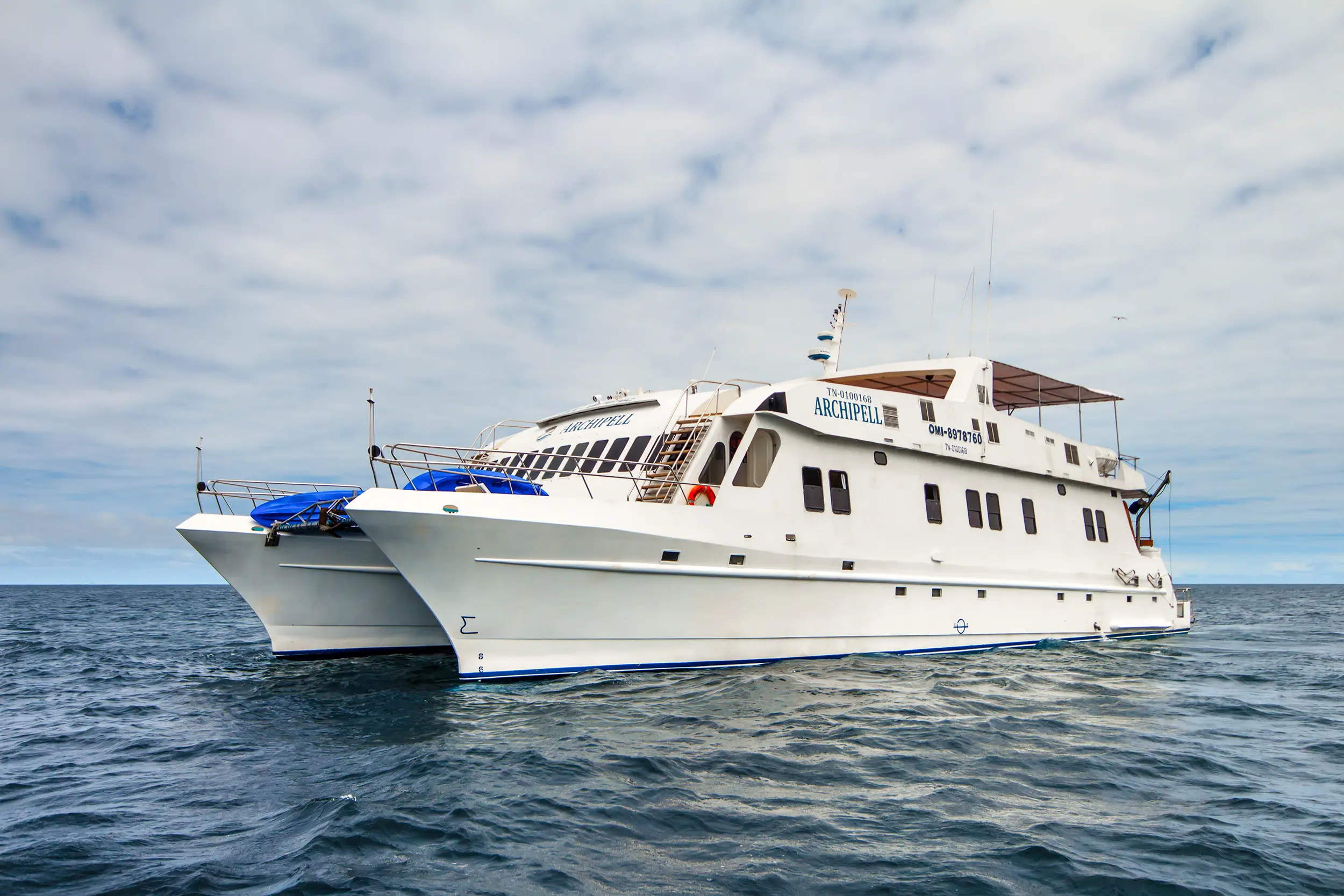
  • Category: Tourist superior Class catamaran
  • Capacity: 16 guests
  • Crew: 9
  • Guide: Naturalist guide
  • Length: 88 ft
  • Beam: 36 ft
  • Speed: 10 knots
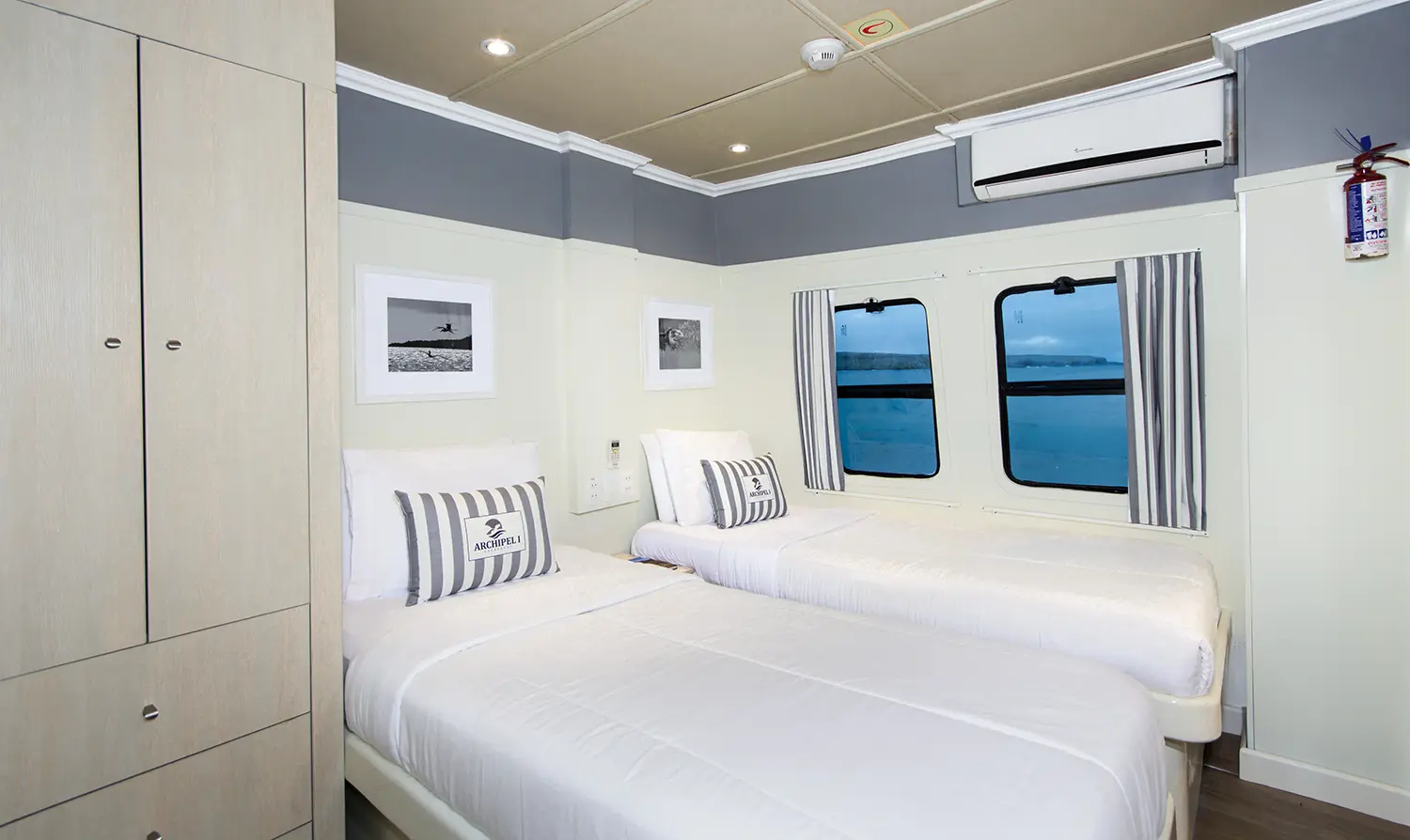
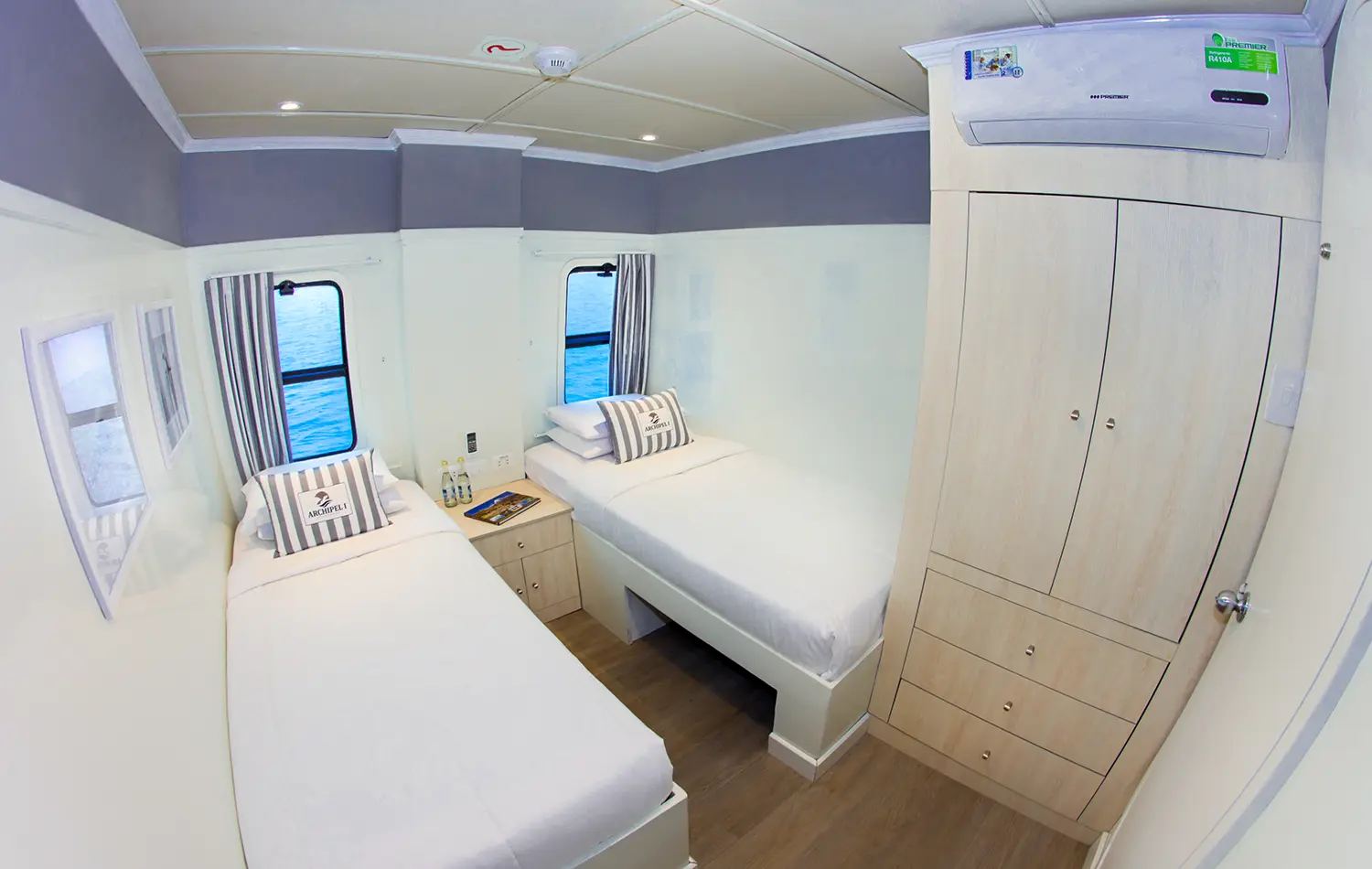
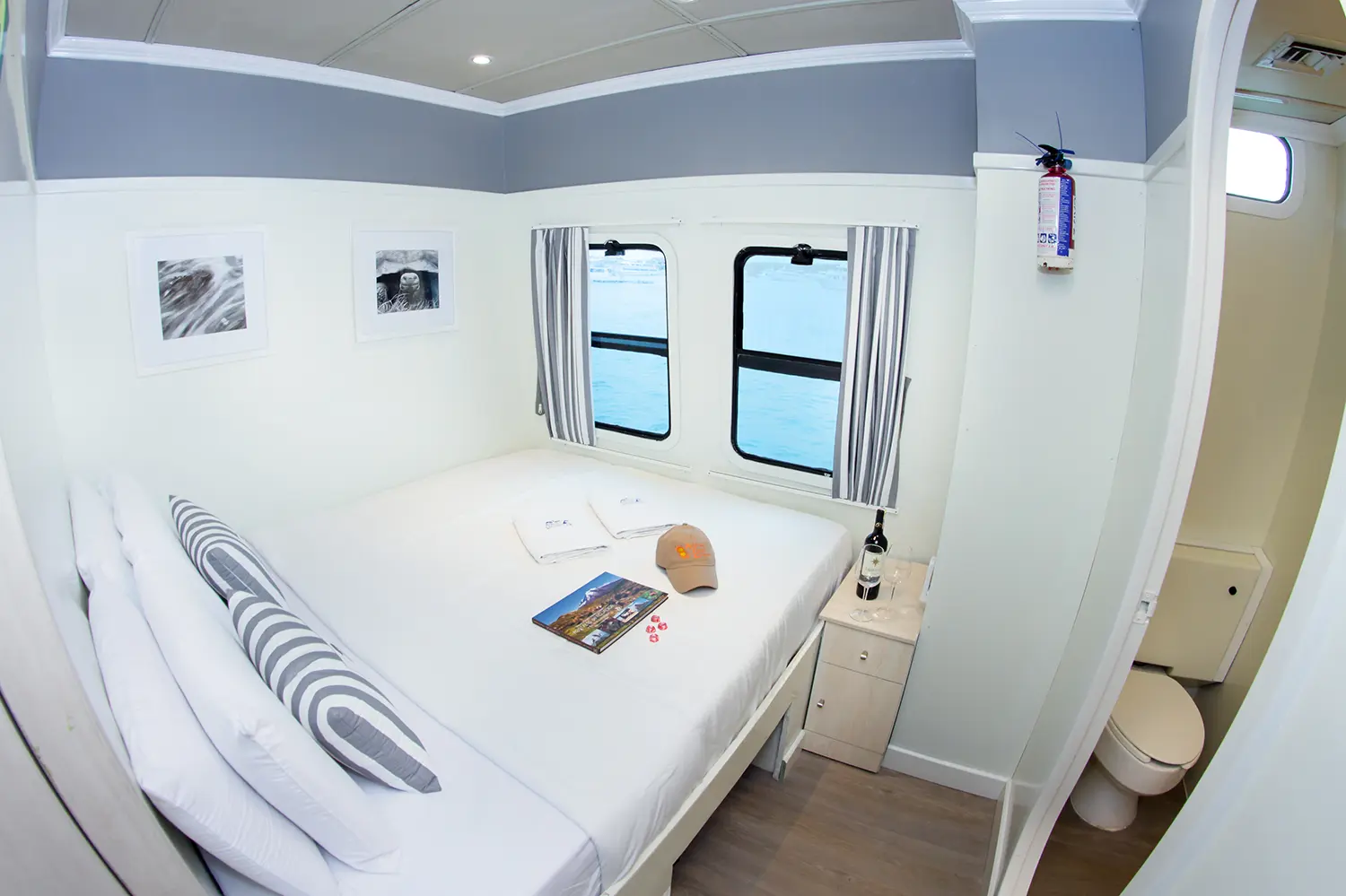
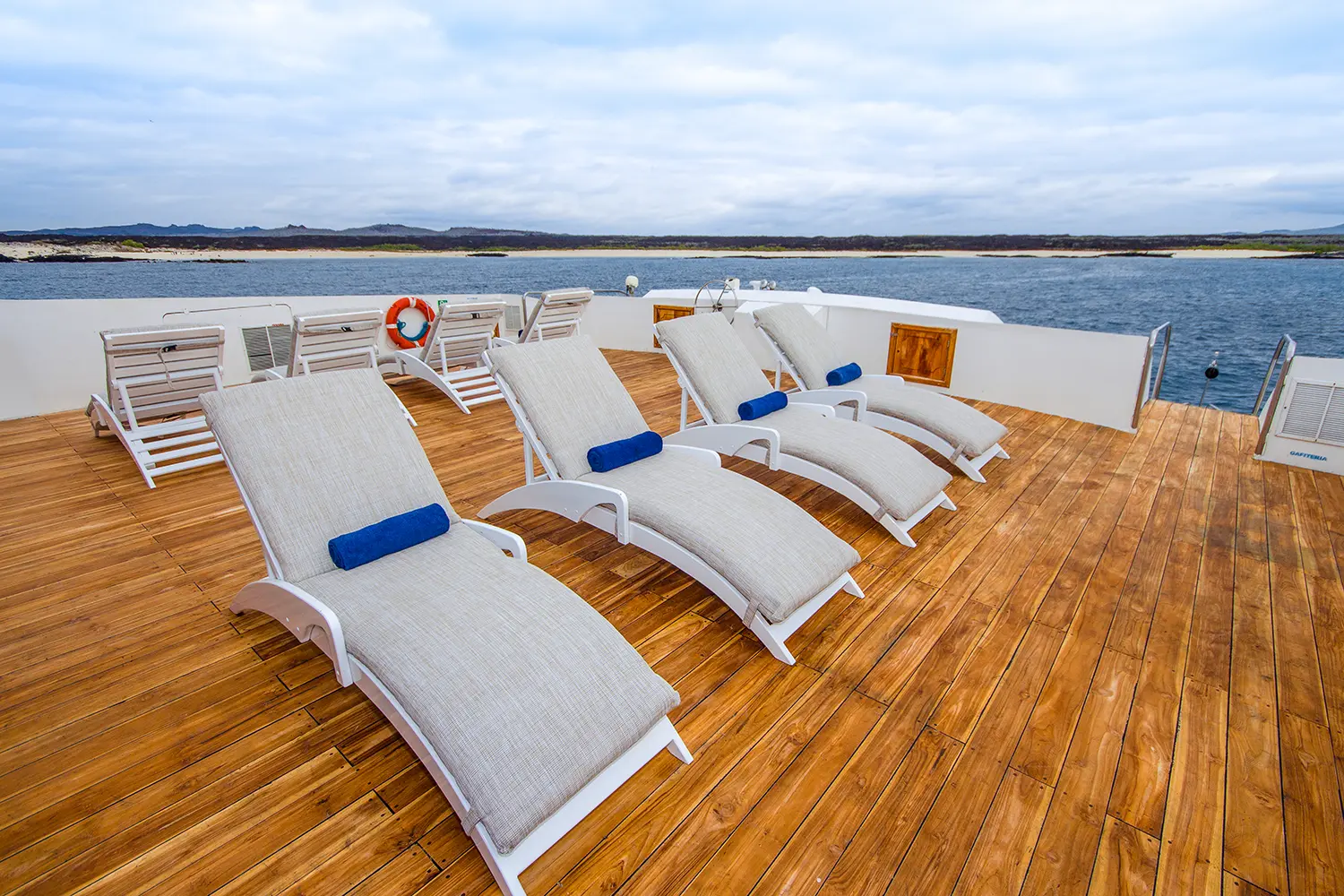
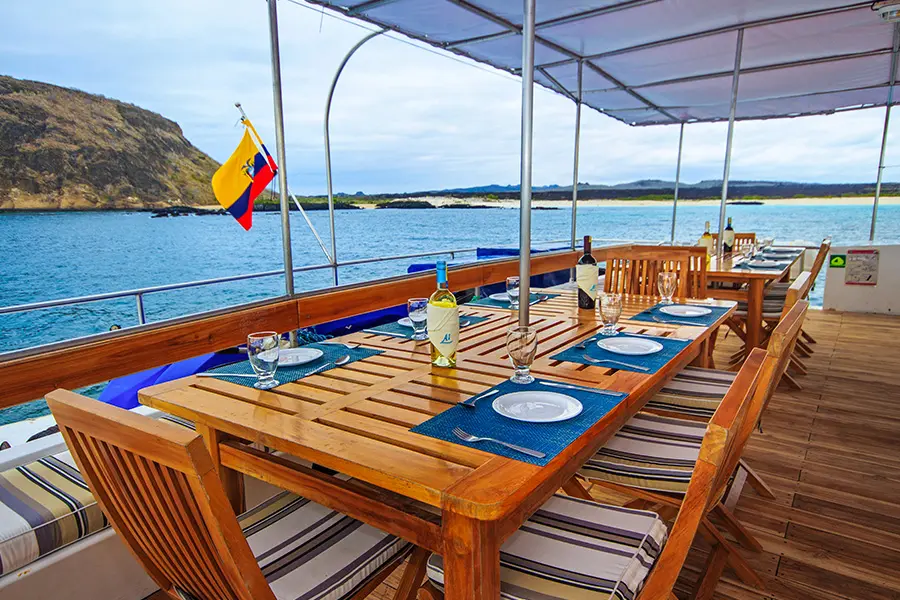
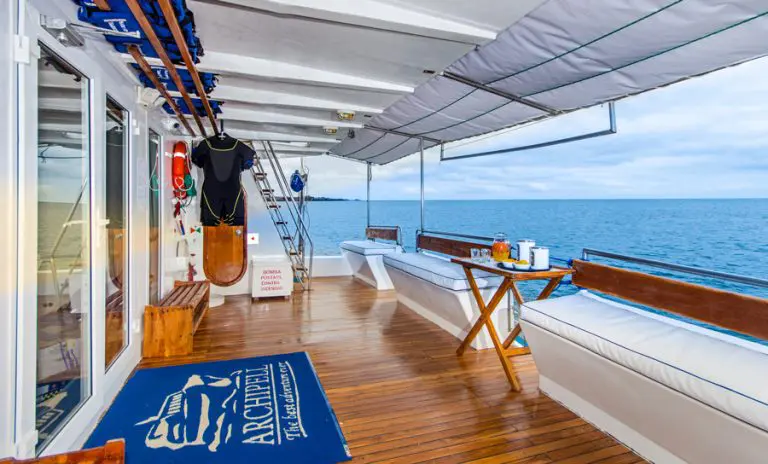
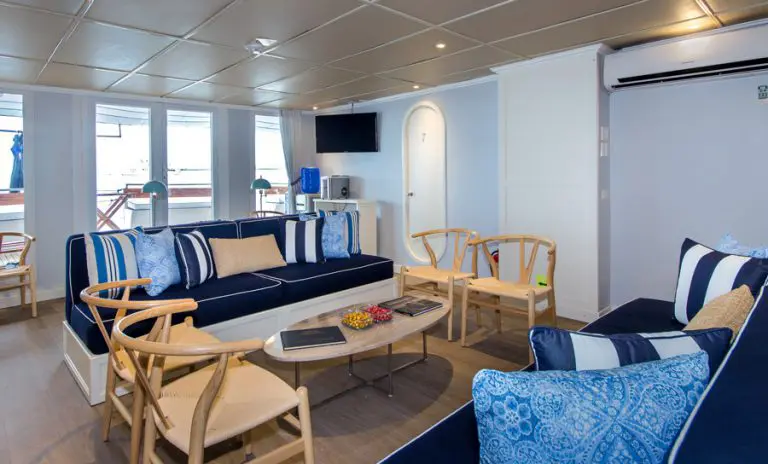
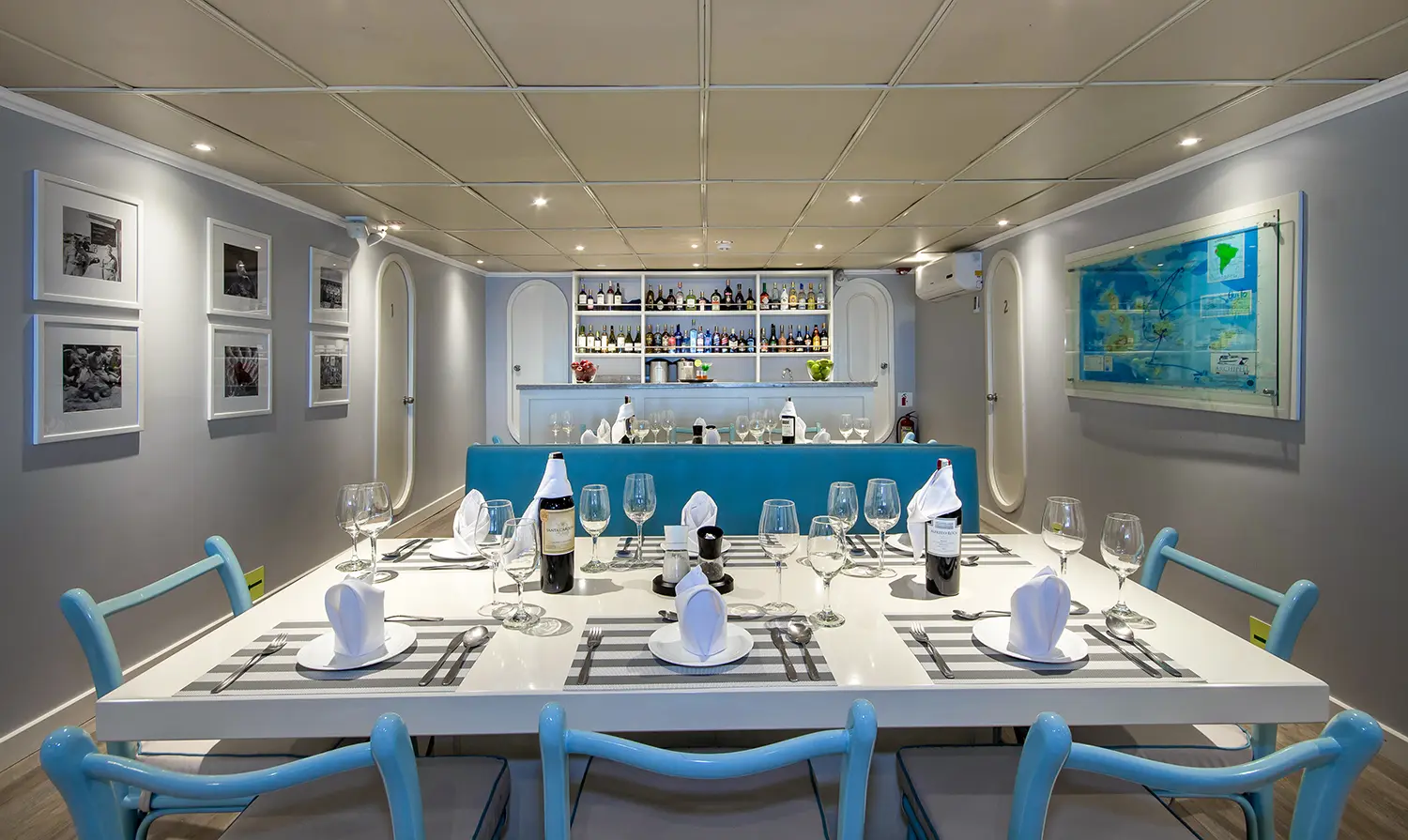
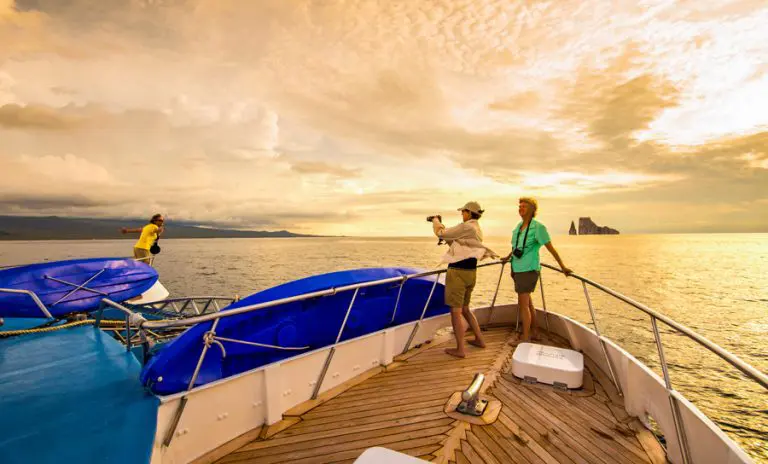
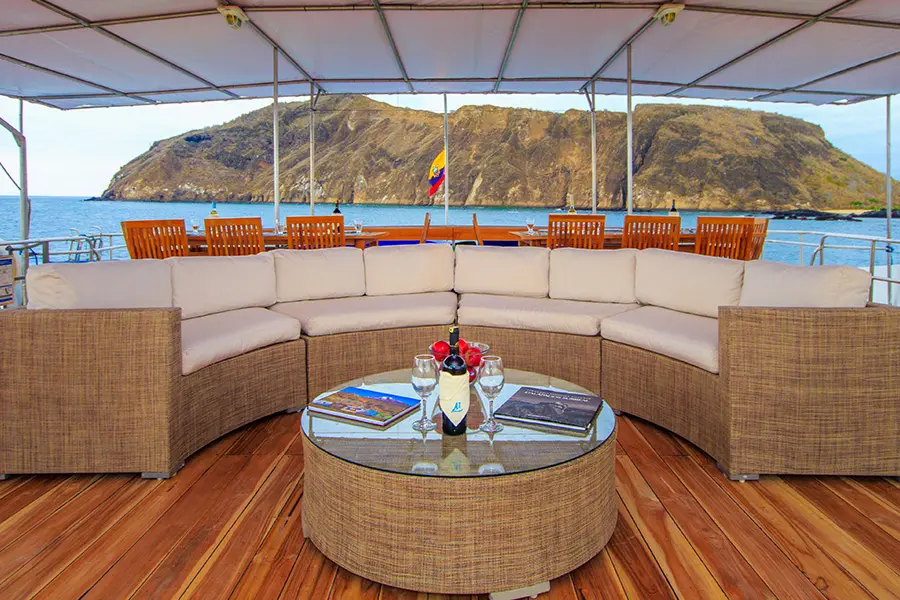
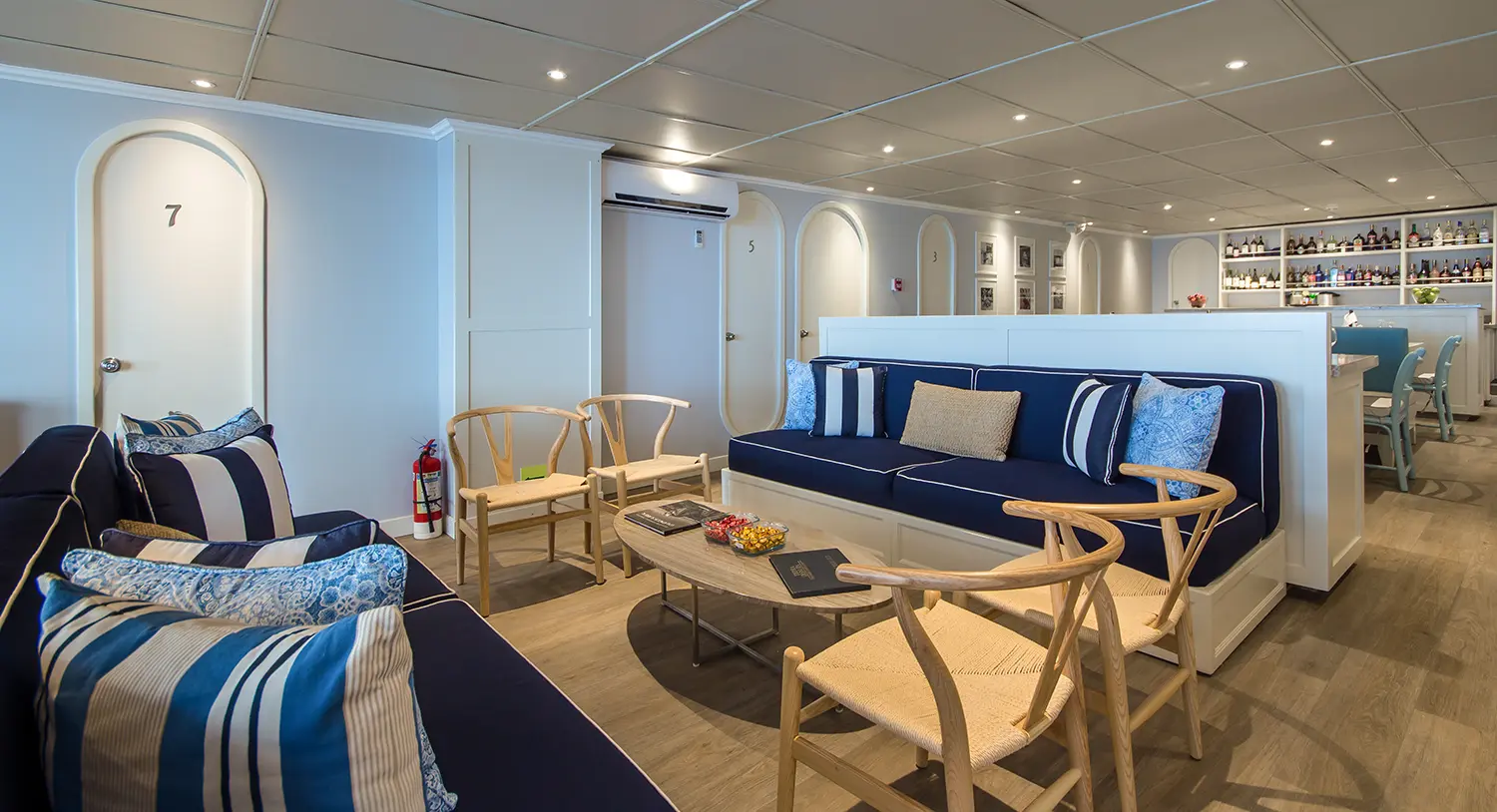
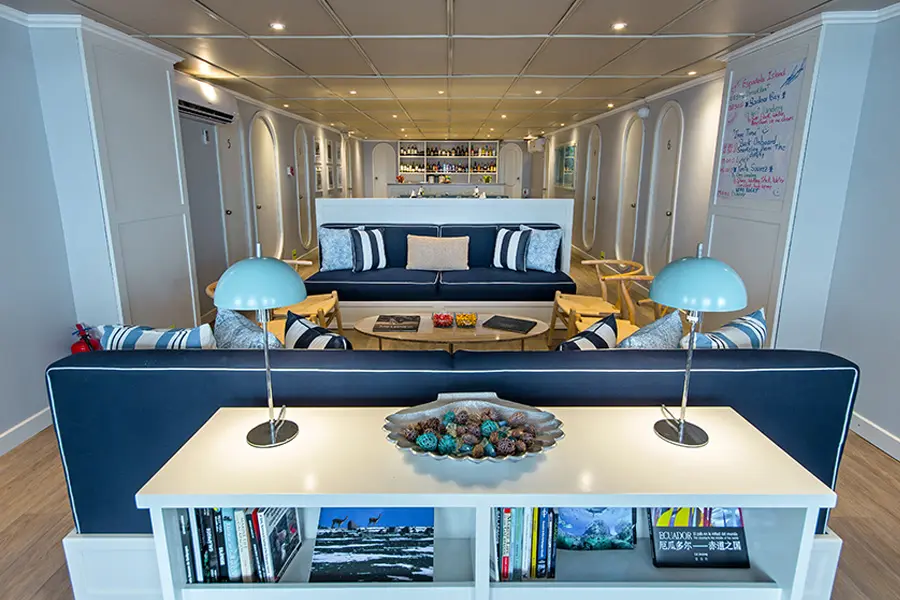
  • Facilities: 8 double cabins with private bathrooms with hot/ cold water showers. Dining room, bar, library, ecologic ventilation system, TV, DVD, stereo, observation deck, sundeck.
M/C Archipel I cabin
M/C Archipel I deck
M/C Archipel I deck
M/C Archipel I deck
M/C Archipel I deck
M/C Archipel I interior
M/C Archipel I restaurant
Prices and Booking request

Dates & Rates

Item 1
PRICE PER PERSON 2024 IN USD
HOTELS CATEGORY 1 PAX 2-3 PAX 4-5 PAX 6-9 PAX 10-11 PAX 12-15 PAX 16 PAX Sing Sup
Tourist $4.060 $2.344 $1.967 $1.650 $1.415 $1.365 $1.273 $405
Tourist Sup $3.589 $2.144 $1.820 $1.555 $1.342 $1.300 $1.220 $425
First Class $5.104 $2.820 $2.429 $2.136 $1.905 $1.856 $1.766 $999
Item 1
PRICE PER PERSON 2025 IN USD
HOTELS CATEGORY 1 PAX 2-3 PAX 4-5 PAX 6-9 PAX 10-11 PAX 12-15 PAX 16 PAX Sing Sup
Tourist $4.154 $2.409 $2.024 $1.699 $1.462 $1.408 $1.317 $415
Tourist Sup $4.343 $2.602 $2.187 $1.858 $1.616 $1.565 $1.470 $449
First Class $5.220 $2.886 $2.492 $2.205 $1.973 $1.920 $1.832 $1.025

To request a quote or make a reservation let's start with your details...*

Arrival date*

Total: $2.395,00
What's Included
  • Accommodation as confirmed.
  • All mentioned meals (full-board); filtered water, tea and coffee.
  • All guided excursions and activities as mentioned in the itinerary by a National Park certified naturalist guide.
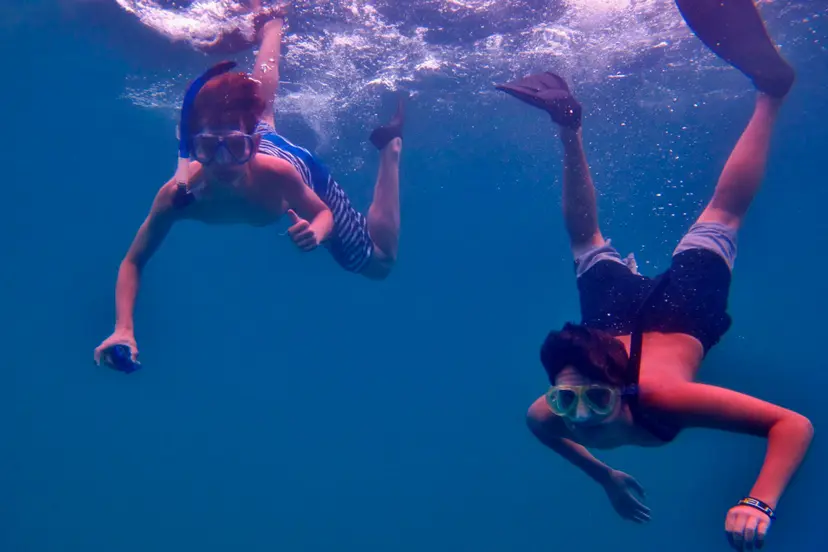
  • Beach towels and snorkelling gear (snorkel, mask, flippers; optional wet-suits for hire).
What's Not Included
  • Round-trip flight to the Galapagos.
  • Soft and alcoholic drinks.
  • Galapagos National Park entrance fee (USD 200 pp).
  • Transit Control Card (USD 20 pp).
  • Personal travel insurance.
  • Personal expenses, extras and tipping.
Galapagos Motor Catamaran
archipel elChato
Archipel I Galapagos yacht
Archipel I Galapagos Yacht Activities
Archipel I Galapagos Yacht Exterior
Motor Catamaran Archipel I
archipel-prince-philips-steps
archipel-sullivan_bay
Archipel I Fausto Llerena Breeding Centre
archipel-caleta-tortuga-negra

Get in touch with us

We customise every trip to you and our quotes are bespoke. We’re here to offer advice, recommendations and answer your questions.
Contact form
Call on +593 991 957 415

Featured activity

Ecuador Birdwatching

Birdwatching tours

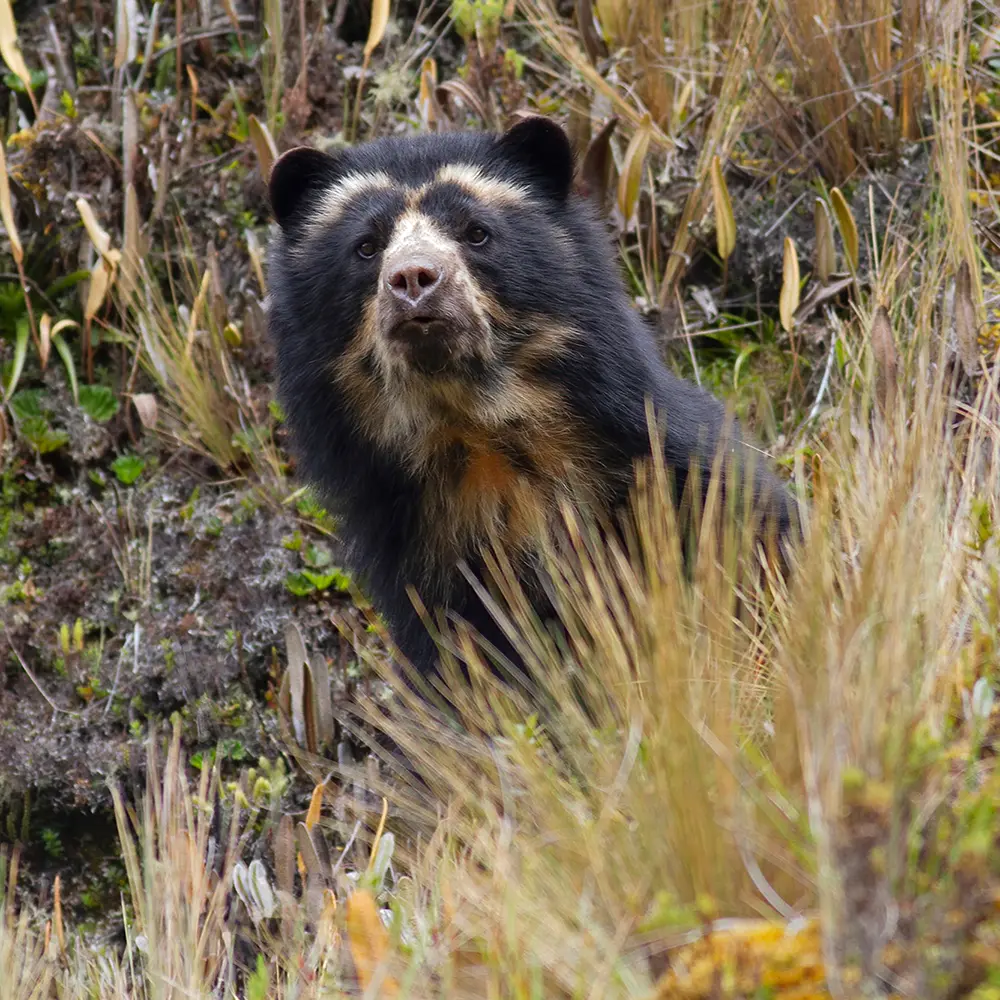
Ecuador is a birder's paradise, boasting an incredible diversity of species across its varied ecosystems. Birdwatching tours in Ecuador offer unparalleled opportunities to spot vibrant hummingbirds in the cloud forests, rare antpittas in the Andes, colorful macaws in the Amazon, and unique endemic species in the Galapagos.
Discover more
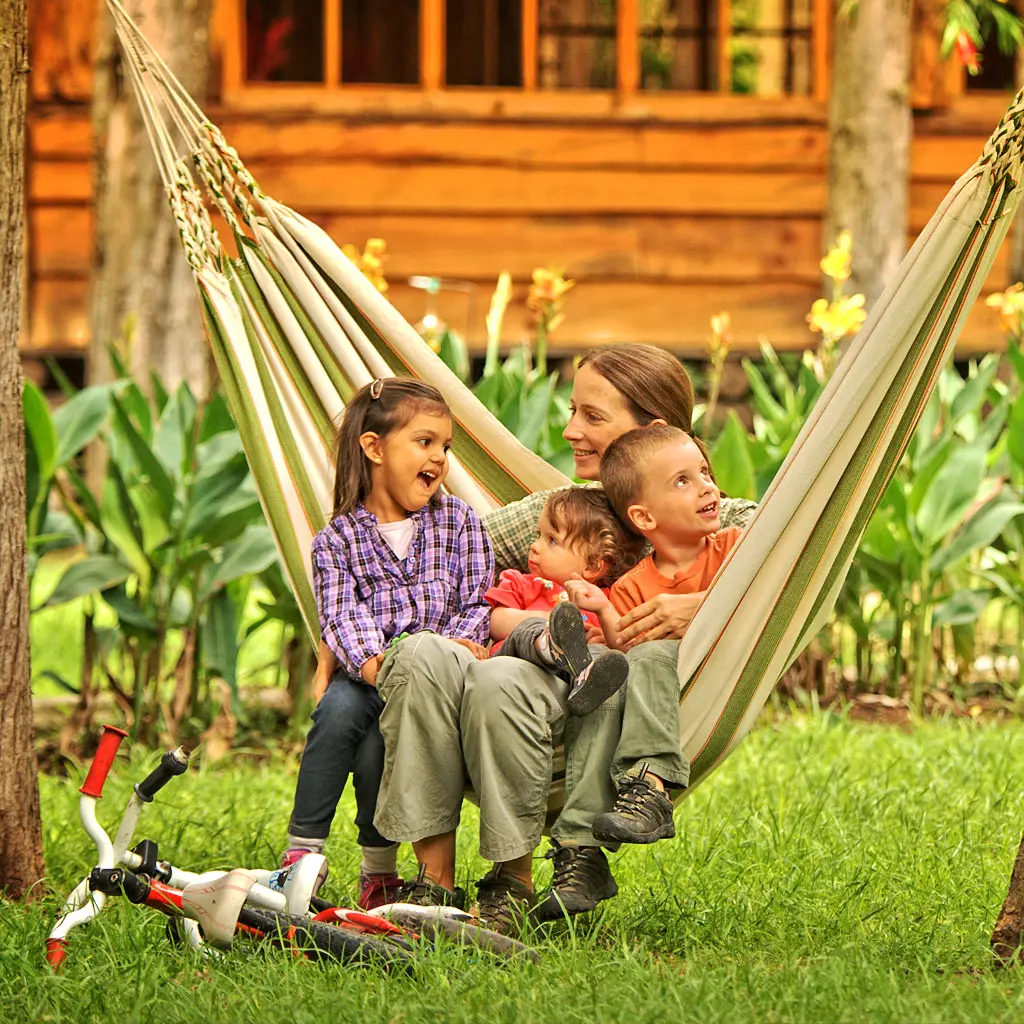
Ecuador Family Journeys Tour

Family Journeys

Family journeys in Ecuador offer diverse and engaging adventures for all ages. From wildlife encounters in the Galapagos and Amazon rainforest that spark wonder in children, to cultural explorations in the Andes highlands with their vibrant markets and charming towns, and relaxing moments on the Pacific coast, Ecuador provides a safe and stimulating environment for creating unforgettable family memories.
Discover more
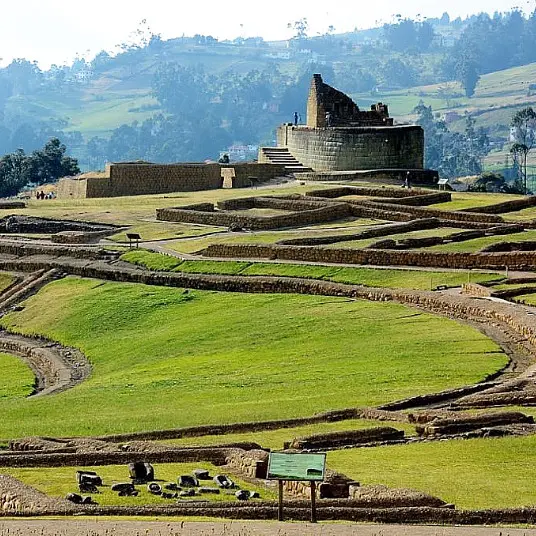
Ecuador History & Archeology

History & Archeology tours

Ecuador's History & Archeology tours delve into a rich past, from ancient pre-Incan civilizations to the grandeur of the Inca Empire and the legacy of Spanish colonialism. Explore meticulously preserved colonial cities like Quito, a UNESCO World Heritage site, discover enigmatic archeological sites such as Ingapirca with its impressive Inca ruins, and learn about the diverse cultures that shaped this fascinating nation.
Discover more
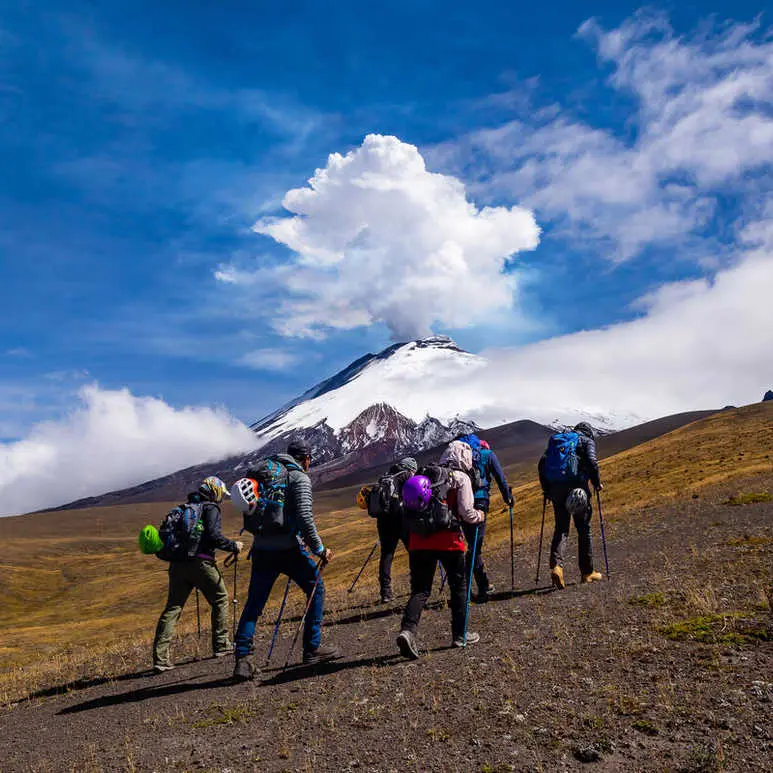
Hiking Cotopaxi Volcano Ecuador

Hiking & Trekking

Ecuador hiking and trekking tours offer an extraordinary range of experiences amidst stunning Andean landscapes. From challenging ascents of majestic volcanoes like Cotopaxi and Chimborazo to scenic multi-day treks through cloud forests and paramo, and more gentle walks to explore indigenous villages.
Discover more
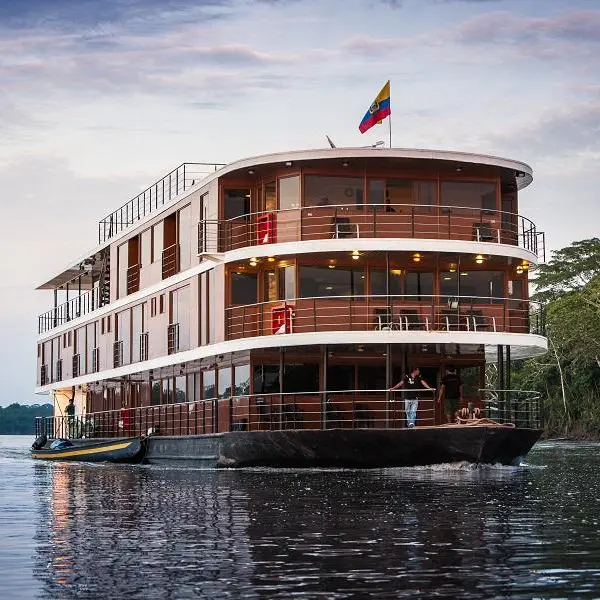
Ecuador boat cruises

Boat Cruises

Ecuador boat cruises primarily focus on the Galapagos Islands, offering an unparalleled way to explore this unique archipelago. Options range from comfortable tourist-class vessels to luxurious yachts, providing accommodations, meals, and daily guided excursions. While less common, some river cruises also operate in the Amazon.
Discover more
Ecuador wildlife tours

Nature & Wildlife tours

Ecuador's Nature and Wildlife tours are an absolute delight for nature lovers, offering unparalleled biodiversity in a compact country. Explore the unique, fearless wildlife of the Galapagos Islands, discover a profusion of species in the Amazon rainforest (monkeys, macaws, anacondas), and encounter rare birds and fascinating mammals in the Andean cloud forests and paramo.
Discover more
Ecuador People Culture Tours

People & Culture tours

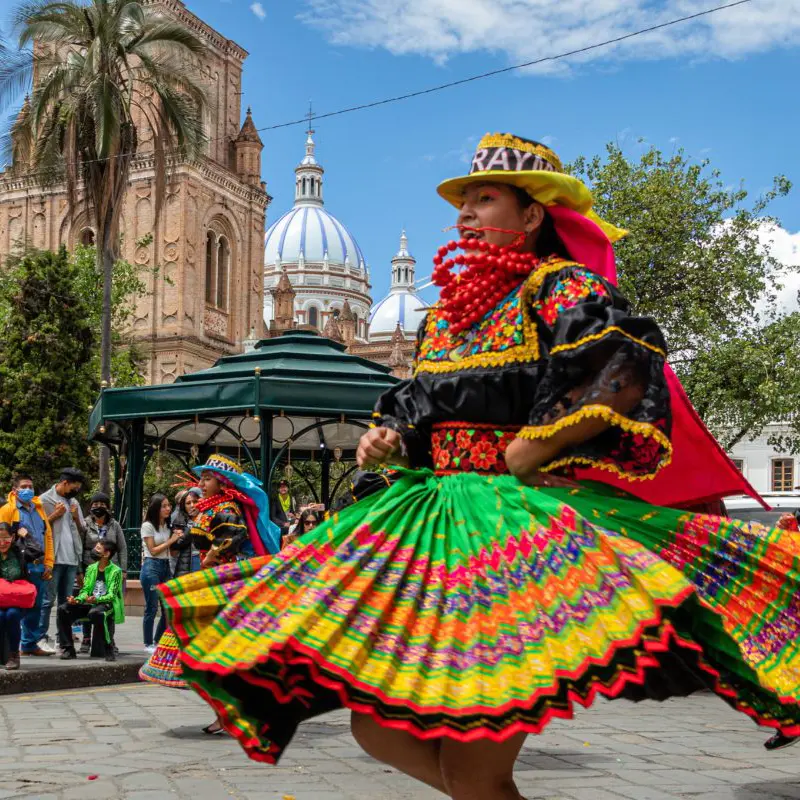
Ecuador People and Culture tours offer a vibrant immersion into the heart of this diverse nation. Explore bustling indigenous markets like Otavalo, where ancient traditions thrive through colorful textiles and handicrafts. Discover the architectural grandeur and living history of UNESCO World Heritage cities like Quito and Cuenca.
Discover more
Ecuador snorkeling and diving tours

Snorkeling & Diving tours

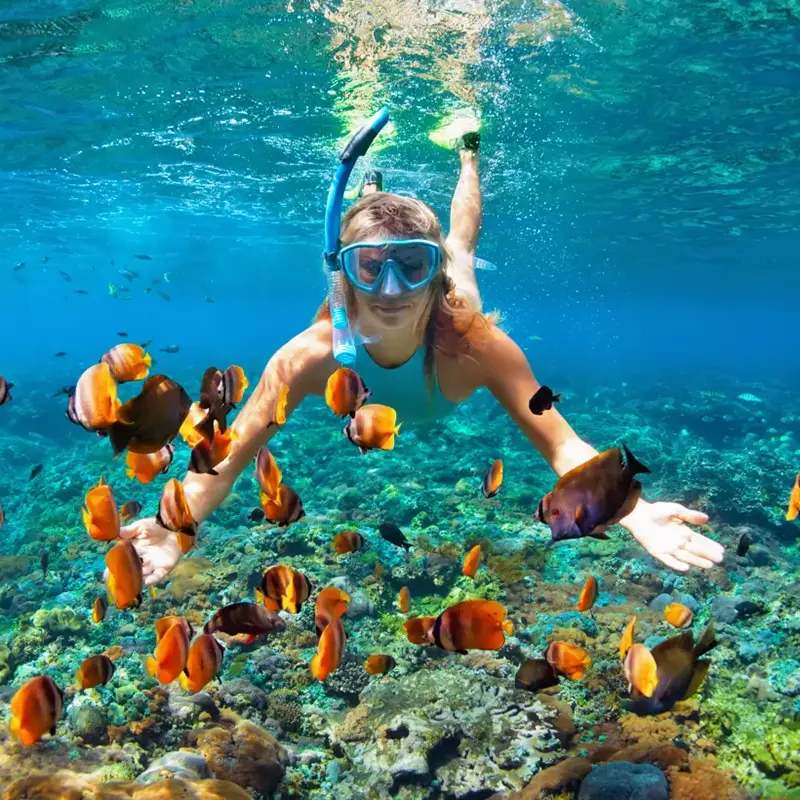
Ecuador's snorkeling and diving tours primarily focus on the Galapagos Islands, offering an unparalleled underwater adventure. Dive into crystal-clear waters teeming with unique marine life found nowhere else: playful sea lions, graceful sea turtles, hammerhead sharks, whale sharks, marine iguanas, and countless colorful fish.
Discover more
Call on +593 991 957 415

Featured destination

Ecuador, Cotopaxi

Ecuador

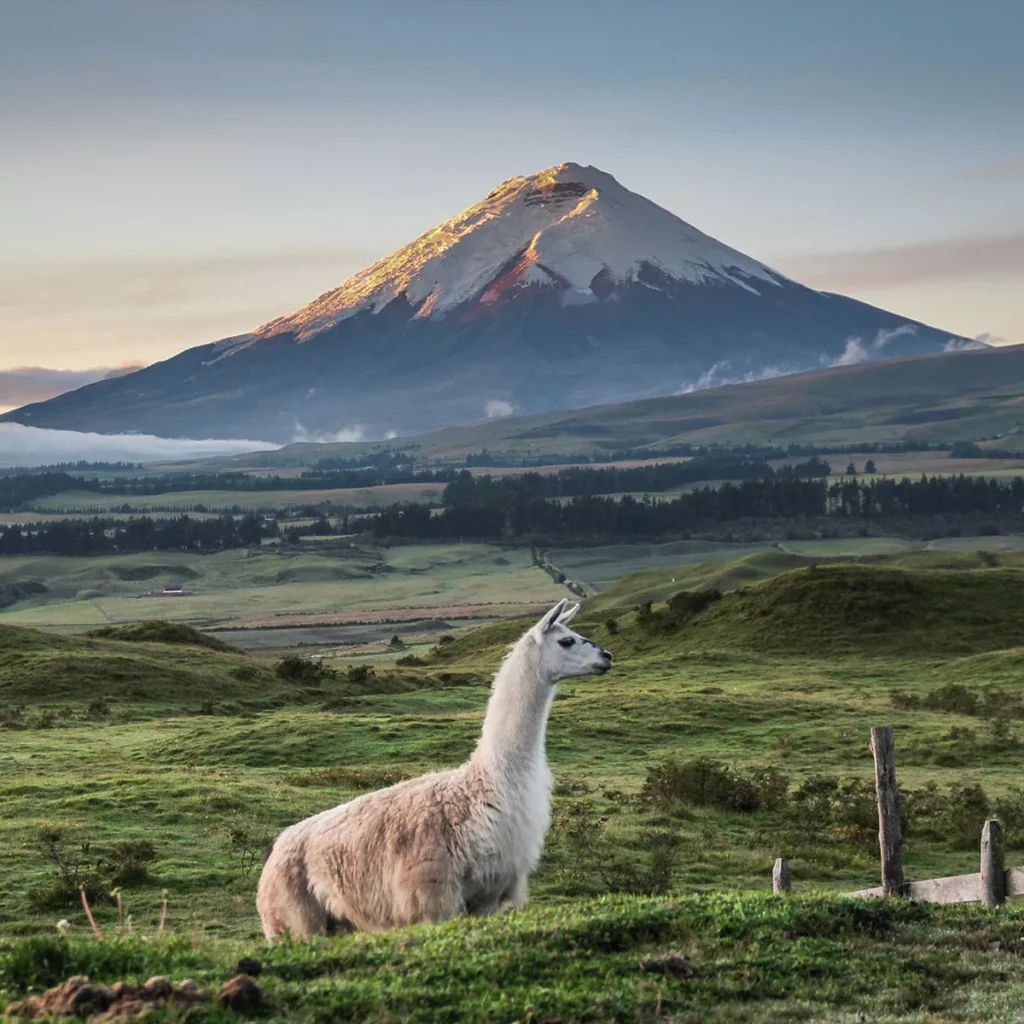
Ecuador travel offers an incredibly diverse and compact experience. From the unique, wildlife-rich Galapagos Islands and the majestic peaks of the Andes Highlands with their vibrant indigenous cultures, to the lush, biodiverse Amazon rainforest and the laid-back Pacific coast, Ecuador packs a world of natural wonders and cultural encounters into a relatively small area.
Discover more
Galapagos Boobie

Galapagos

Galapagos tours provide an incredible opportunity to explore a unique volcanic archipelago teeming with fearless, endemic wildlife. Led by knowledgeable naturalists, these multi-day excursions offer close encounters with diverse species through guided walks, snorkeling, and boat navigation, revealing the islands' raw beauty and evolutionary marvels.
Discover more
Ecuador Amazon Rainforest

Rainforest

Ecuador rainforest expeditions offer deep dives into the heart of the Amazon, providing unparalleled immersion in one of the world's most biodiverse ecosystems. These journeys combine thrilling wildlife encounters—spotting monkeys, vibrant birds, and elusive predators—with cultural exchanges with indigenous communities, all while navigating lush landscapes and winding rivers.
Discover more
Cuenca, Ecuador

Highlands

Explore the vibrant heart of Ecuador's Andes with activities like hiking majestic volcanoes (Cotopaxi, Chimborazo), exploring picturesque colonial cities (Quito, Cuenca), bargaining for unique crafts at bustling indigenous markets (Otavalo), and discovering hidden cloud forests. Enjoy horseback riding, mountain biking, or simply soaking in the breathtaking mountain vistas and rich cultural heritage.
Discover more