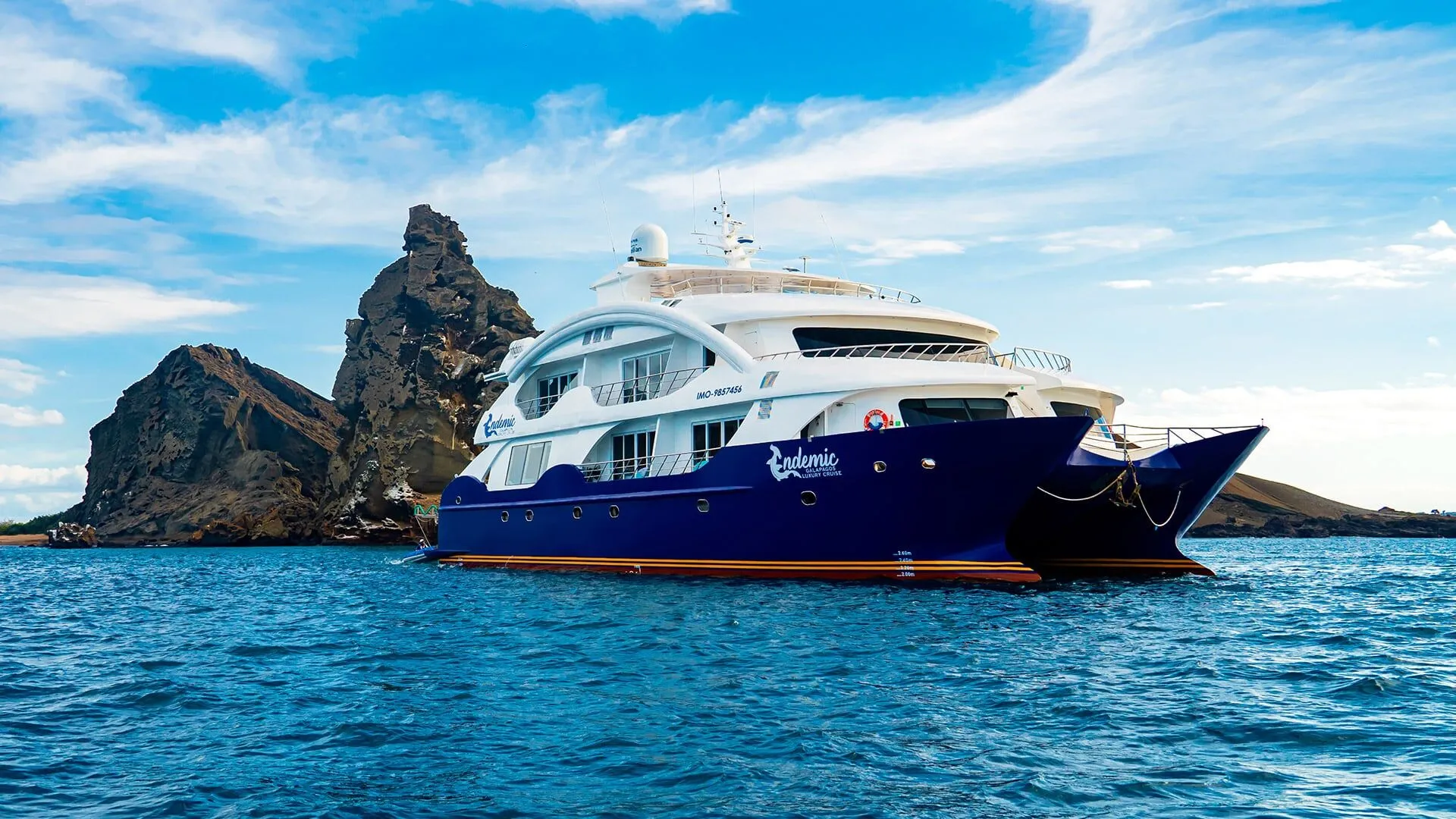
Ultimate luxury experience Aboard Galapagos luxury yacht, M/C Endemic
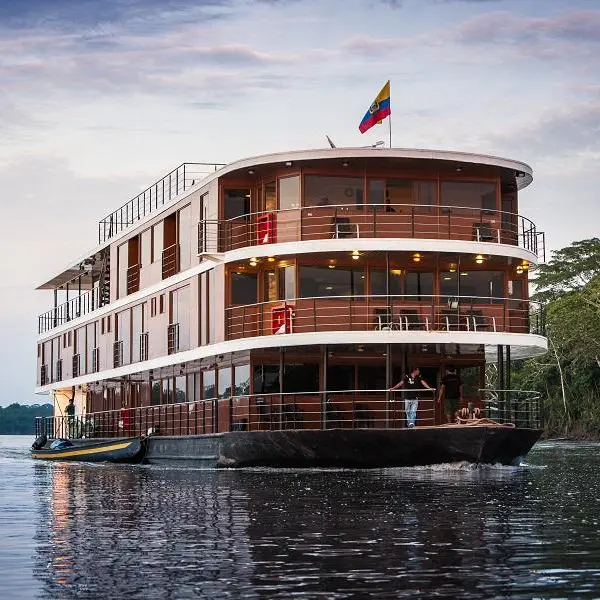
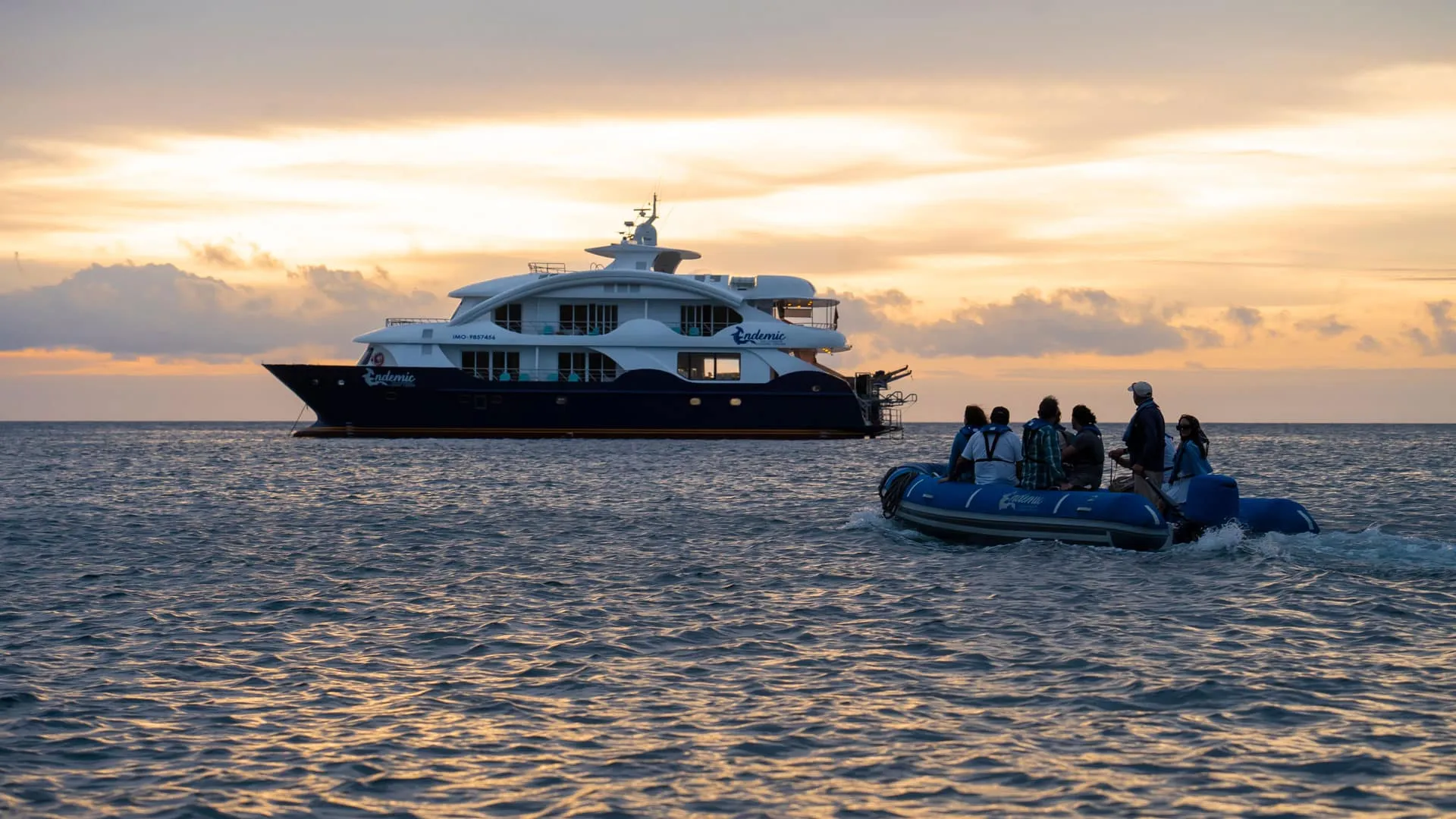
The Galapagos Endemic reflects the highest standards of elegance and innovation, delivering a premium luxury experience in the Galapagos archipelago.
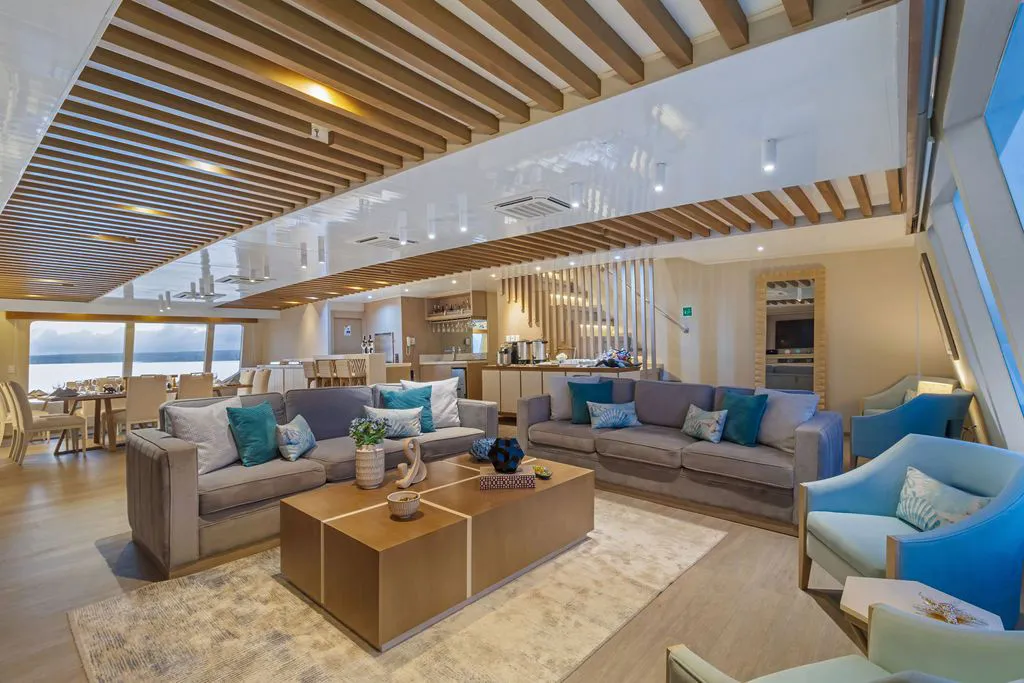
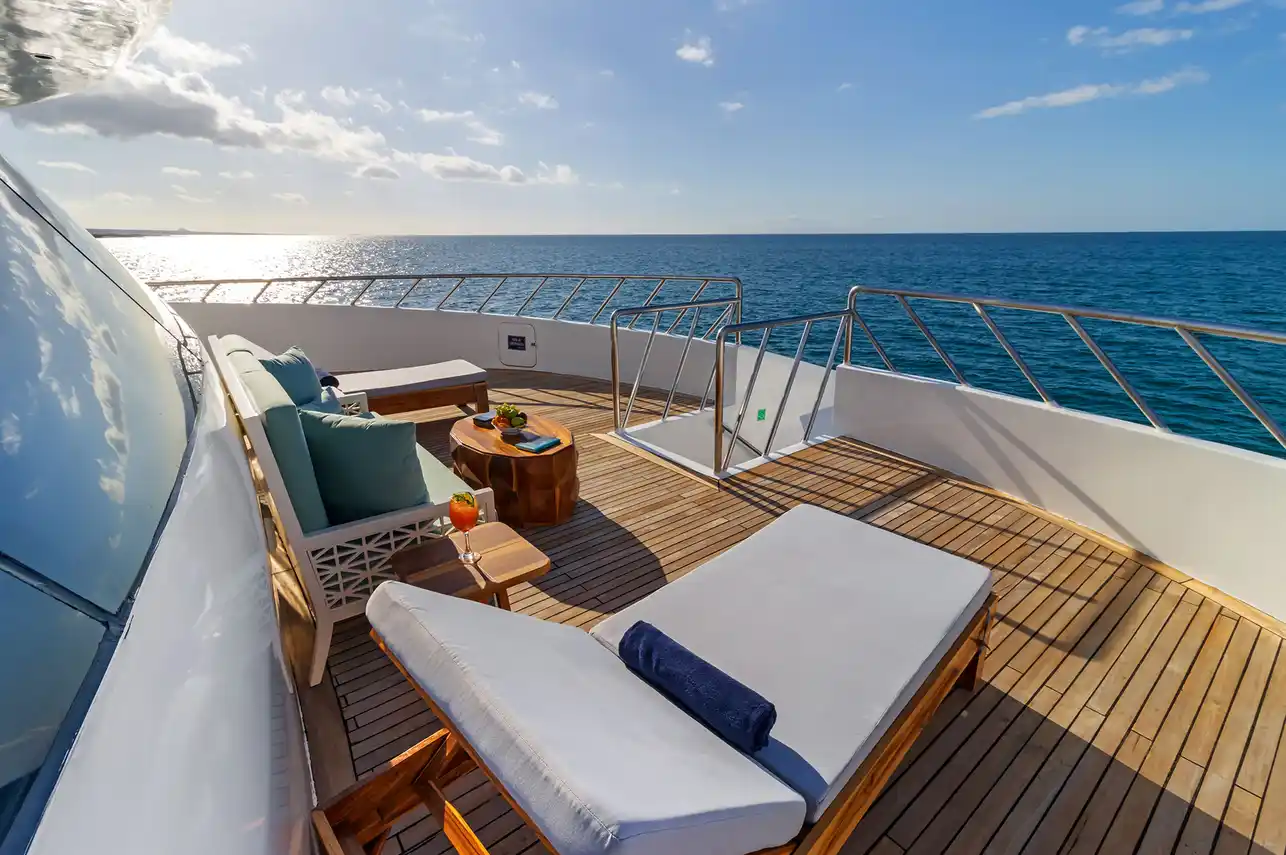
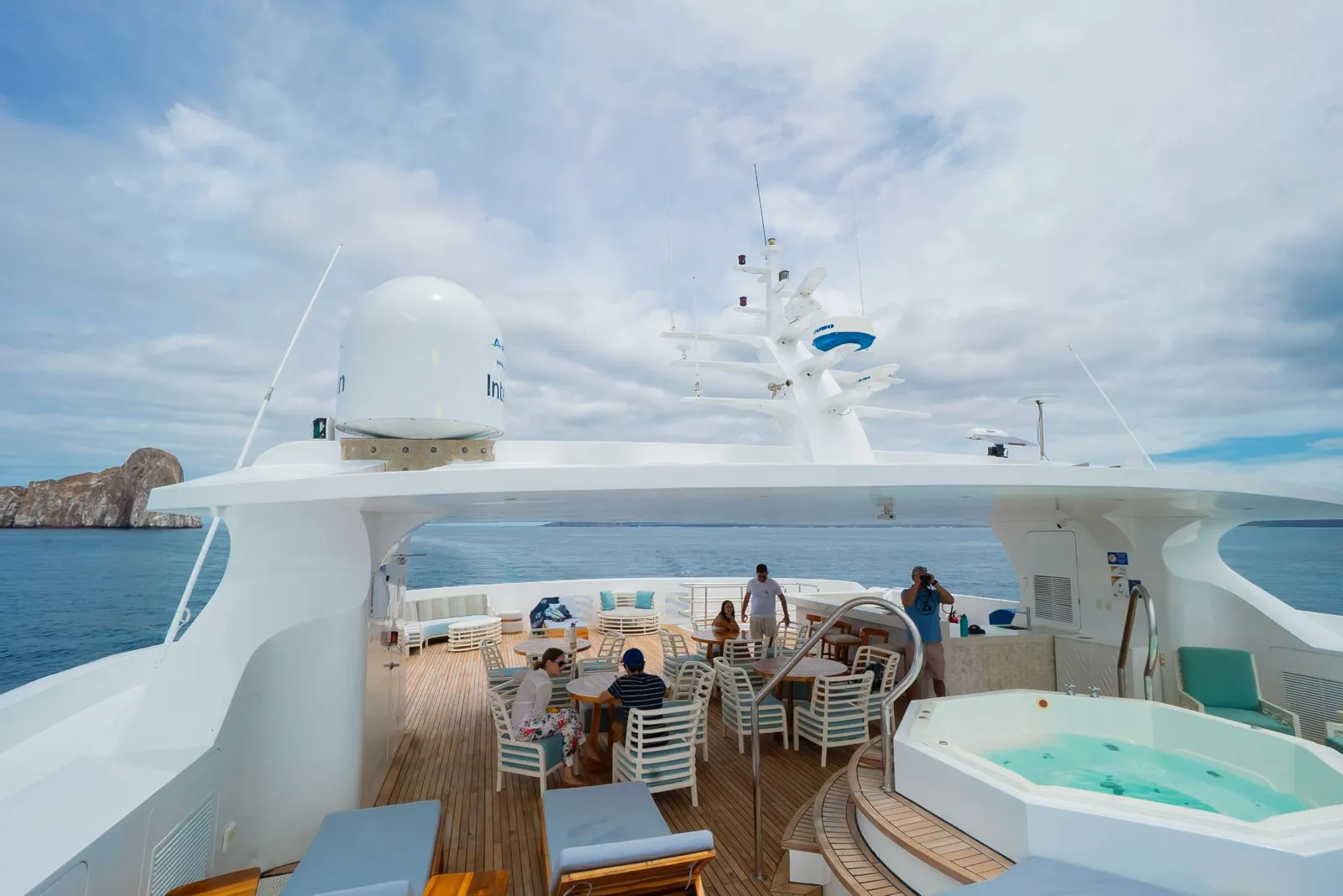
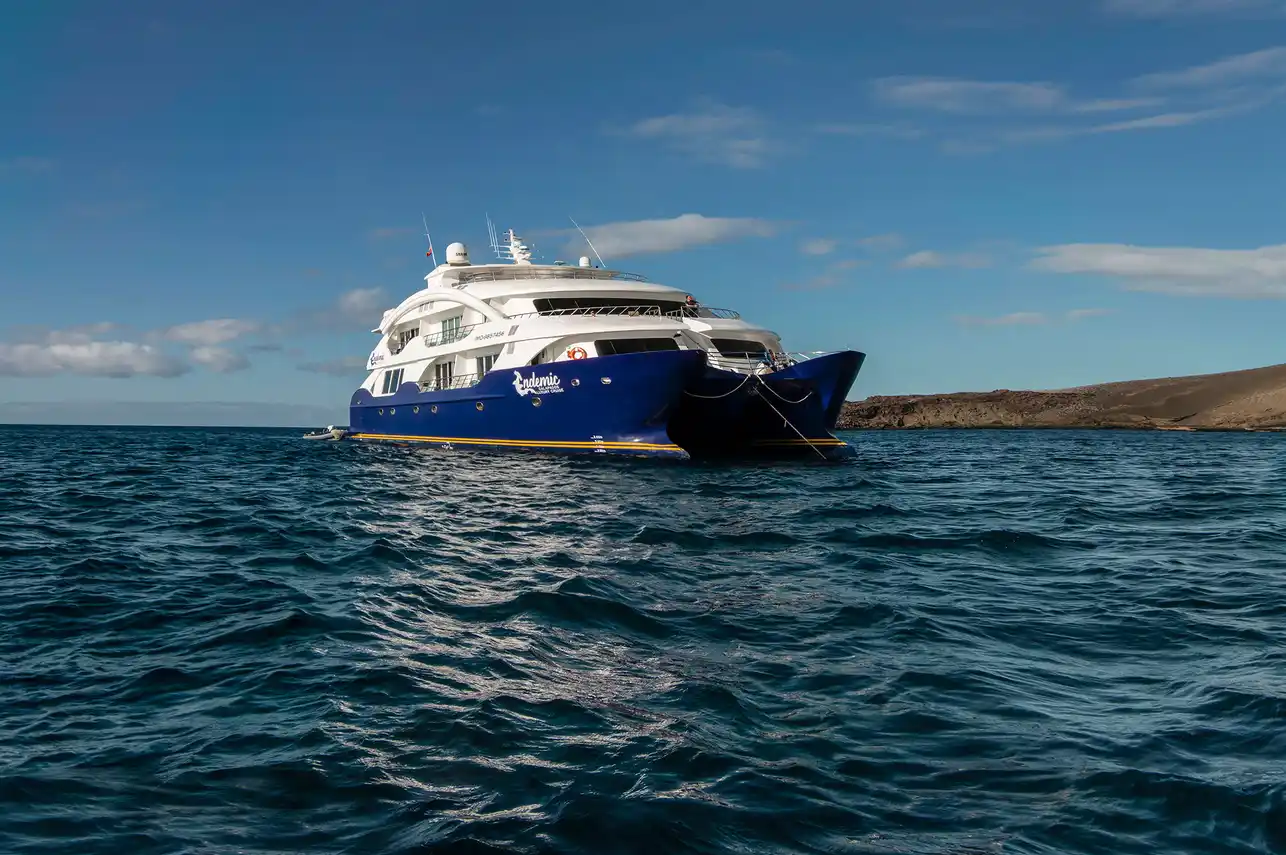
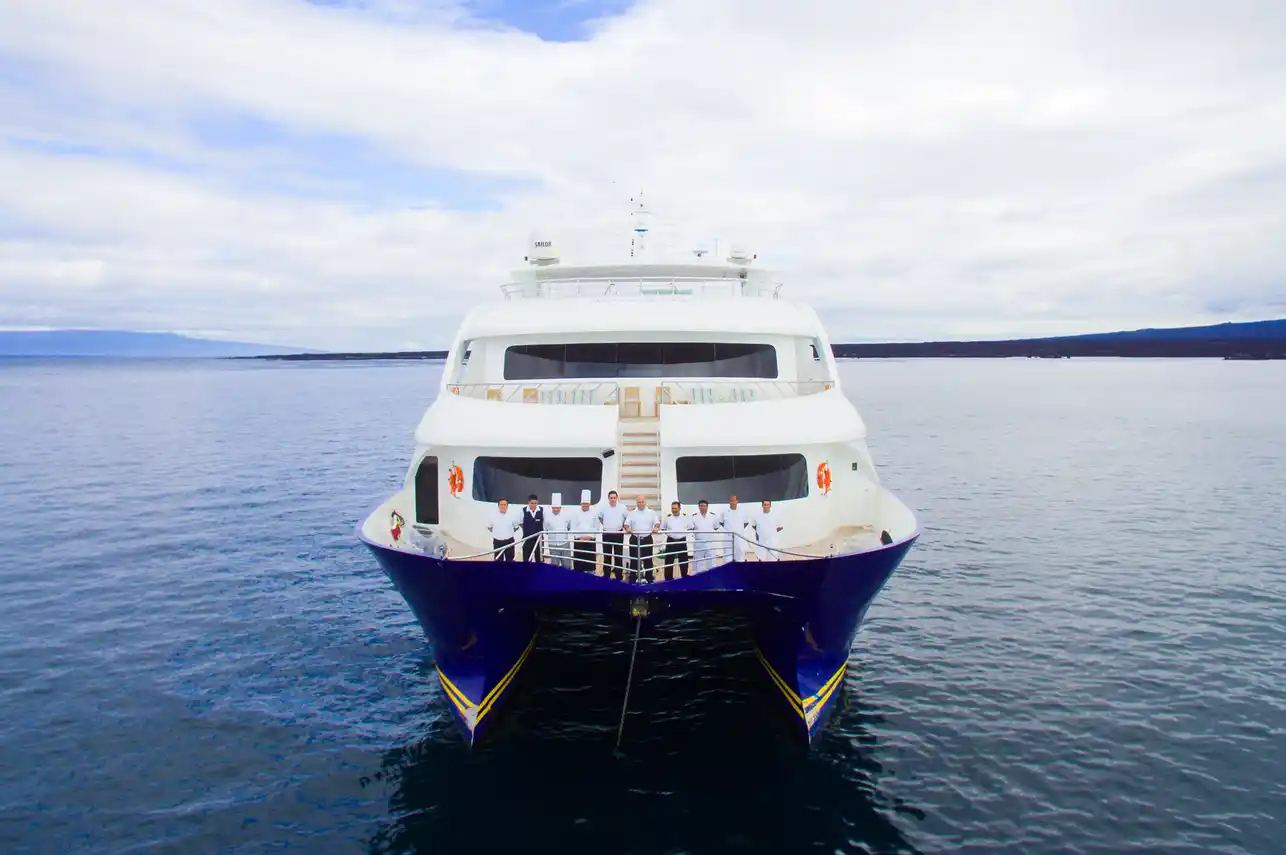
Endemic catamaran accommodates 16 guests with a nearly one-to-one service ratio from its crew and guides. Its dual-hull design enhances stability, creating expansive, luxurious spaces both in the suites and across the vessel’s social areas. Unlike traditional single-hulled ships, Endemic redefined luxury cruising in the Galapagos.
Itinerary
Itinerary C 5D/4N (Sunday - Thursday)
Day 1: Baltra – Santa Cruz
AM: Baltra
Baltra Island Airport.
PM: Sta.Cruz: Dragon Hill
Visit Dragon Hill will take place, which is located in the north-western part of Santa Cruz island. Here you will have the opportunity to walk into the island and view the land iguana. Be among these magnificent reptiles, that just a few decades ago were on the brink of extinction. Moreover, at Dragon Hill you will see a flamingos’ lagoon, pintail ducks and other endemic birds including flycatchers and warblers. After a short trek, amazing view awaits us up the hill. Offshore snorkeling before returning to the yacht.
Day 2: San Cristobal
AM: Kicker Rock – Wizard Hill
In the morning, the first spot to be visited is Kicker Rock, an impressive geological formation due to erosion. This is a nesting place of sea birds and a nice spot to take pictures while the vessels circumnavigate around the rock.
The next attraction to see is Witch Hill, a tuff cone hill located south west from San Cristobal. This name comes from the Spanish name of the bird known in English as Vermilion Flycatcher.
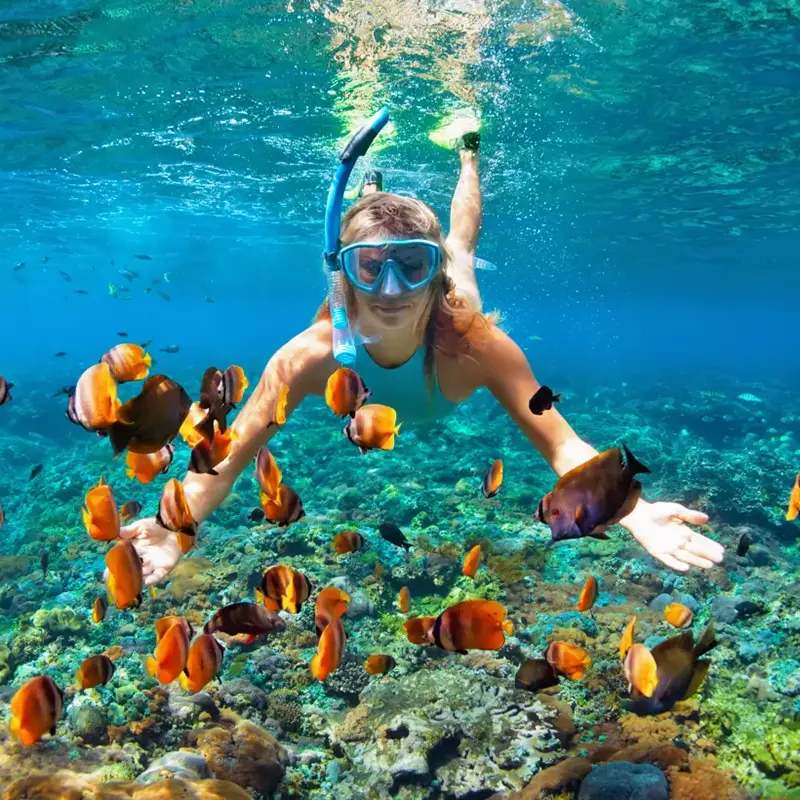
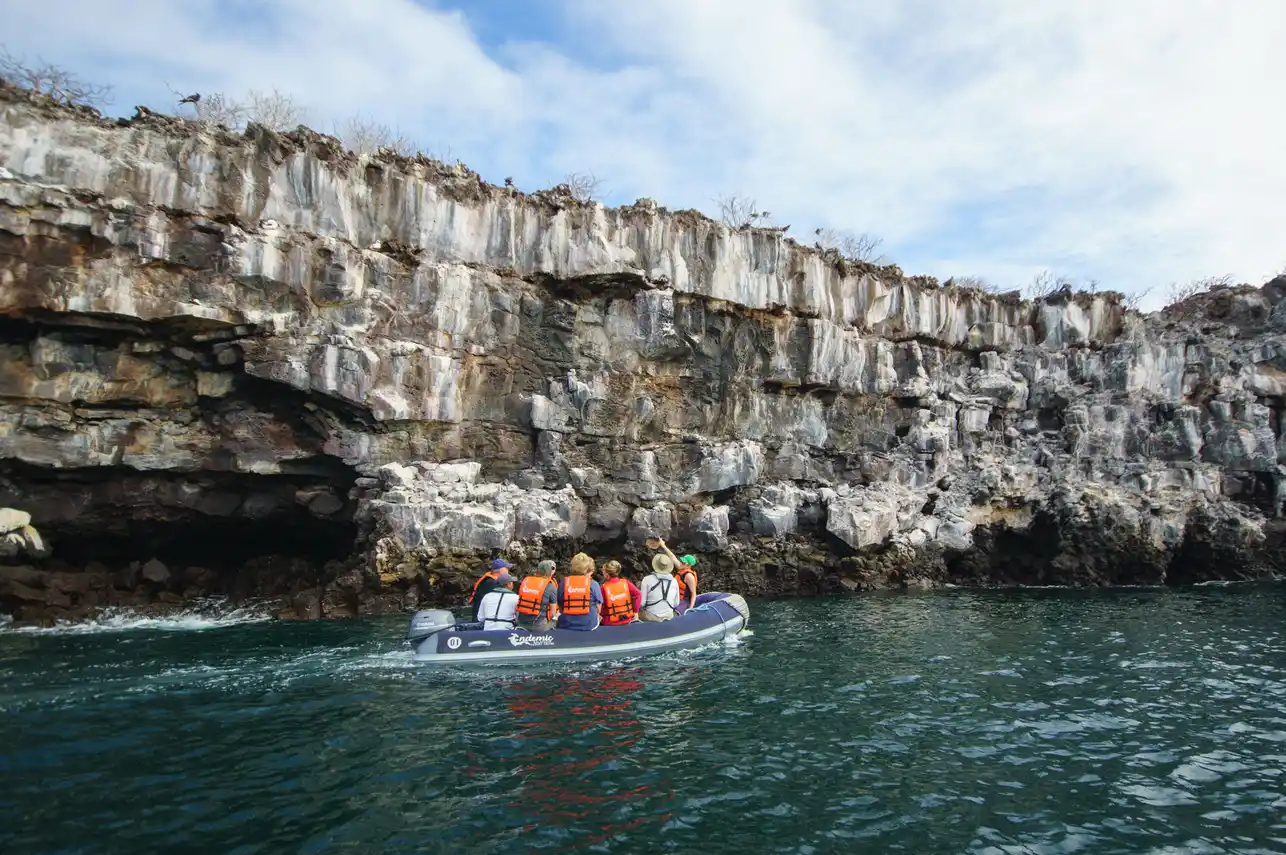
A zodiac ride will take passengers into amazing rock formations along the island shore. A white sand beach and crystal – clear waters are part of this enchanted location. Fantastic opportunity for snorkeling.
PM: Lobos Island
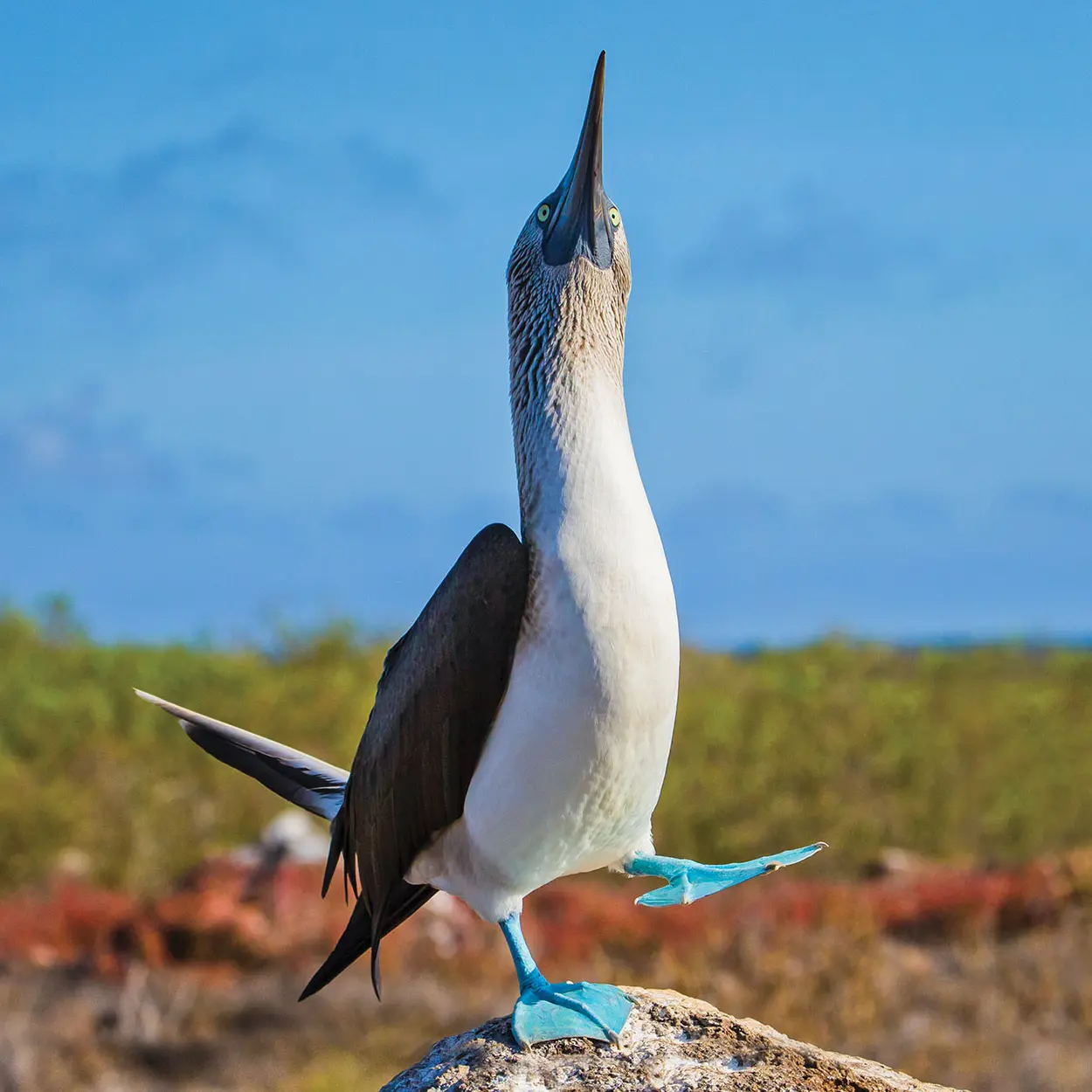
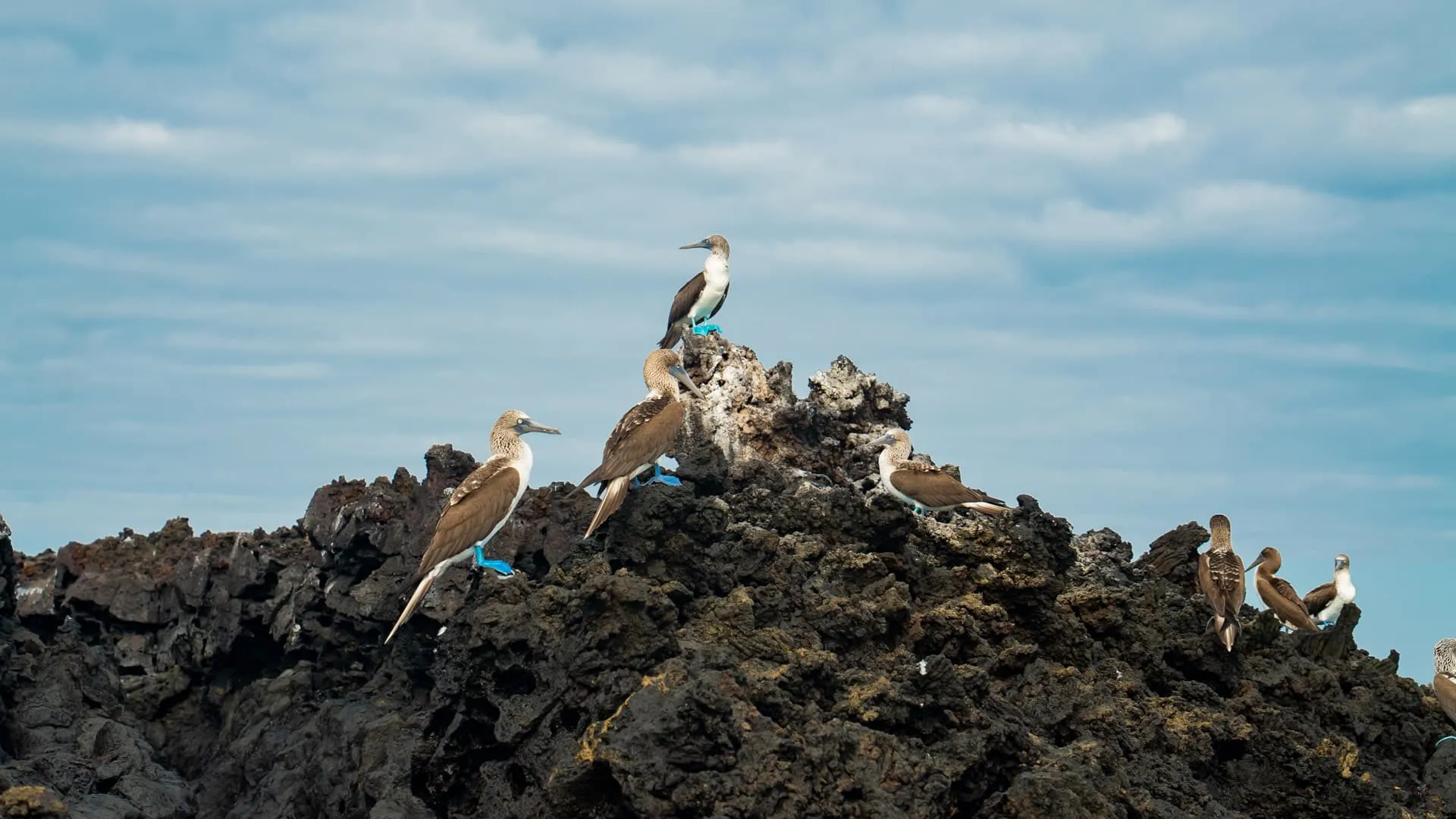
In the afternoon, you will be taken to Lobos Island, where a small population of blue – footed boobies, frigates, marine iguanas, and great frigate birds nesting can be observed. Snorkeling with sea lions in this calm bay is also part of the excursion.
Day 3: Española
AM: Gardner Bay – Gardner and Osborn Islet
Gardner Bay is a pristine white sandy beach (one of the longest in the Galapagos), that is home to colonies of sea lions and inquisitive mockingbirds. It is also one of the world’s most important breeding sites for the waved albatross. A short dinghy ride will take you to the Osborn and Gardner Islets, which are superb locations for snorkeling with young sea lions and a greater variety of tropical fish and corals.
PM: Suarez Point
Suarez Point is an area with an outstanding variety of wildlife. The walking trail will take you past nesting sites of Nazca and blue-footed boobies, whilst Galapagos doves, mockingbirds and finches can be seen foraging nearby. You will also pass a geyser which can spray water up to 25m into the air; a spectacular feat of nature. Finally, when you reach the top of the breaktaking cliffs, you can enjoy watching waved albatrosses launching themselves out across the ocean.
Day 4: Santa Fe - Sta. Cruz
AM: Santa Fe
This island was formed as a result of a volcanic uplift millions of years ago and is inhabited by the endemic yellow-green Santa Fe iguana, Galapagos snake and rice rat. There are two main trails on the island, one that leads to a beach through a forest of tall Opuntia (prickly pear) trees; another that takes you into the highlands and culminates in a stunning cliff top viewpoint where Galapagos hawks can be sighted. It is also possible to snorkel along the shoreline with the highly entertaining sea lions.
PM: Santa Cruz: Fausto Llerena Breeding Center/Highlands
The Darwin research centre is instrumental in carrying out important scientific research into the preservation of the archipelago’s ecosystems and initiating a significant breeding programme in 1970 for giant tortoises. As well as accessing a wealth of information about the flora and fauna found across the islands, you will have the chance to see tortoises at all stages of their development. Having been reared in captivity, they are very accustomed to humans, so don’t miss out on getting a photo with one of these remarkable animals.
As part of your day, we will head towards the Highlands of Santa Cruz to admire the famous giant tortoises in the wild. It is impressive to see these endemic animals that give the name to the archipelago, Galapagos. Birdwatching is also one of the activities in the highlands, since this area is home of finches and other Galapagos birds. Finally we walk into lava caves to see the enormous lava flows that formed the islands before continuing back to the M/C Endemic.
Day 5: South Plaza - Baltra
AM: South Plaza
One of two small islets, South Plaza island houses a rich diversity of wildlife and vegetation. After passing a large colony of sea lions and ascending the slopes, you may catch a glimpse of swallow-tailed gulls, Nazca boobies, red-billed tropic birds, frigates or the rare lava gull. The ground is carpeted in Sesuvium, which transforms from bright red in the dry season to a vibrant green in the wet season, and land iguanas crowd around towering prickly pear cacti, waiting patiently for their juicy fruits to fall.
PM: Baltra
Departure from Baltra Island Airport
Itinerary E 6D/5N (Thursday-Tuesday)
Day 1: Baltra - Bartolome
AM: Baltra
Arrival to Baltra Island Airport
PM: Bartolome
After lunch, you will discover Bartholomew Island. Once here, you will ascend to admire the spectacular panorama of the Sullivan Bay and the famous Pinnacle Rock. The beaches at the foot of the Pinnacle Rock are excellent for snorkeling from which you can discover the marvelous underwater world, and with a little luck, you’ll get to snorkel with penguins.
Day 2: Floreana
AM: Devil’s Crown – Cormorant Point
Cormorant Point features two distinctly beautiful beaches, one tinted a glistening green by a high content of olivine crystals; the other pure white and aptly referred to as ‘flour beach’. The saltwater lagoon here is frequented by one of the largest populations of flamingos in the Galapagos as well as common stilts and white-cheeked pintails. Devil’s Crown is a stunning jagged volcanic crater, which has become mostly submerged beneath the water. It boasts a plethora of marine life making it an enthralling site for diving and snorkeling.
PM: The Baroness Overlook – Post Office Bay
Post Office Bay provides a fascinating insight into the human history of the island as you will discover the postal system developed by British whalers in the 18th century and can take part in the tradition that has continued to this day. The Baroness’ Viewpoint is named after an Australian baroness, who visited the island in the 1930’s and sparked a number of speculations about her mysterious disappearance. This vantage point is ideal for surveying the surrounding mangroves and other points of interest from above.
Day 3: Santiago - North Seymour
AM: Santiago: Chinese Hat
This small island off the coast of Santiago Island is a result of erupted lava, and the remaining cone curiously resembles the shape of a Chinese hat. The short trail around the cove will guide you through a sea lion colony and provide opportunities to see eagles, oystercatchers and lava lizards. Furthermore, the channel of aquamarine water that runs between Santiago Island is very appealing to those who wish to enjoy some snorkeling, where you may be joined by sharks, rays and even a rare Galapagos penguin.
PM: North Seymour
This island was formed by the uplifting of lava from underneath the ocean resulting in a relatively flat landscape. As well as land iguanas, sea lions and turtles along the coast, inland you will see colonies of blue-footed boobies who you may be lucky enough to catch performing their delightful courtship dance. Most notably though, the island is the largest nesting site for magnificent frigate birds, the male variety of which possess distinctive red gular pouches that they inflate during the mating season.
Day 4: Sta. Cruz
AM: Black Turtle Cove
After breakfast, enjoy the visit to Black Turtle Cove, which is located on the north shore of Santa Cruz. It is a living illustration of how mangroves alter the marine environment to create a rich and unique habitat. Three mangrove species crowd the area from the shore out into the lagoon, which reaches almost a mile inland.
As you drift through quiet waters in the zodiac, you are likely to see spotted eagle rays and diamond shaped mustard rays, which swim in a diamond formation. White – tipped reef sharks slip beneath the boat and Pacific green sea turtles come to the surface for air and to mate. Waterfowl, including pelicans, herons and egret, all feed in the cove. This is a peaceful place that will make you feel calm.
PM: Bachas Beach
In the afternoon, visit to Las Bachas, which is a beautiful white – sand beach, located on the northern coast of Santa Cruz Island. There you can go for a stroll or do some easy snorkeling in the gentle surf. Sea turtles lay their eggs at the edge of the vegetation. You can also look for a rusted pontoon, a relic of the Second World War. In fact, “bachas” is a poor pronunciation of “barges,” two of which were wrecked offshore at that time: the locals mispronounced the name and it stuck.
Day 5: Genovesa
AM: Darwin Bay
Arrive at this horse-shoe shaped island and step ashore the white sand and coral beach that was formed by a submerged volcanic crater. This is an ideal place to snorkel in calm, sheltered waters amongst hammerhead sharks, rays and a plethora of colourful reef fish. A short trail leads past a tidal lagoon and mangroves, home to a variety of land bird species, including Nazca and red-footed boobies and swallow-tailed gulls. The top of the craggy hill provides the perfect viewpoint to pause and look down on the bay below.
PM: Prince Philip’s Steps
Begin your expedition at the bottom of the rocky stairway where you may be lucky enough to spot a small colony of seals. As you ascend the steep steps up the 25 metre cliff face, be sure to look out for the sea life nestled in the crevices and flocks of storm petrels, short-eared lava owls and Galapagos doves. Catch your breath at the top and take in the dramatic view before continuing along a rocky lava plateau that is a popular nesting spot for red-footed boobies and frigates.
Day 6: Sta.Cruz - Baltra
AM: Sta.Cruz: Highlands
On the highlands of Santa Cruz, you’ll have the opportunity to see the famous giant tortoises in the wild. So renowned are these endemic animals that they gave the archipelago its name. Birdwatching is also one of the activities do to in the Santa Cruz highlands, since this area is home of finches and other Galapagos birds.
PM: Baltra
Departure from Baltra Island Airport
Itinerary F 6D/5N (Tuesday - Sunday)
Day 1: Baltra - Santiago
AM: Baltra
Arrival to Baltra Island Airport.
PM: Santiago: Sullivan Bay
As a result of a relatively recent volcanic eruption, Sullivan Bay is covered in unusual black rope like formations of cooled lava with small openings known as ‘hornitos’ (literally meaning ‘little ovens’), caused by the release of pressure built up under the surface. Despite the seemingly hostile environment, you will still find many Sally Lightfoot crabs and marine iguanas, and can top of your visit with a swim or snorkel with sea lions and penguins.
Day 2: Isabela
AM: Tintoreras/Sierra Negra Volcano
Las Tintoreras is a group of small islets off the coast of Isabela Island, known for their striking dark lava formations that create a distinctive habitat for diverse wildlife. This makes it an excellent spot for water activities such as dinghy rides, snorkeling, kayaking, and paddleboarding. Visitors often get the chance to see turtles, sharks, penguins, and sea lions up close.
Sierra Negra is among the most active volcanoes in the Galapagos and boasts the world’s second-largest caldera. Hiking to the top takes you through guava tree forests, and on a clear day, you’ll be rewarded with breathtaking views of the island’s five other volcanoes.
PM: Arnaldo Tupiza Breeding Center/The wall of tears
Located just outside Puerto Villamil, the wetlands, comprising of lagoons, swamps and mangroves, are a paradise for migratory birds such as stilts and flamingos. Next, a visit to the intriguing historical site known as The Wall of Tears built by prisoners between 1945-1959, sheds light on the island’s human history. Finally, a visit to the Breeding Centre provides a rare opportunity to see giant tortoises at all stages of development and find out about the invaluable work that is being carried out to preserve and protect this incredible species.
Day 3: Isabela
AM: Elizabeth Bay
This is an exclusive area teeming with wildlife, that is only accessible by dinghy. It is surrounded by a number of islets, where blue-footed boobies and penguins can be sighted on the rocks, and the bay itself features an unusually high and colourful mangrove forest. The cool, calm waters attract schools of fish, and make it a popular place for turtles, rays, sea lions and even sharks to gather, giving rise to a thrilling location for snorkeling and swimming.
PM: Urbina Bay
Located at the foot of the Alcedo and Darwin volcanoes, the Urbina Bay is a product of a major volcanic uplift that occurred in 1954. As a result, the shore is strewn with corals and remains of marine life. However, in a relatively short space of time, endemic plant species and wildlife have already started to thrive. It will certainly be hard to miss the impressive giant land iguanas (the largest in the Galapagos), but also keep an eye out for Galapagos hawks, giant tortoises and the Darwin’s cotton plant.
Day 4: Isabela - Fernandina
AM: Isabela: Tagus Cove
Known to have been a popular anchorage site since the 1800s, here you will be able to see where the names of ships have been carved into the rocks, providing an intriguing historical record. A scenic trail will lead you around Darwin Lake, and if you choose to continue up to the top of the hill you will be rewarded with a majestic view back over the crystal clear waters of the lagoon; an unmissable photo opportunity.
PM: Fernandina: Pta. Espinoza
This untouched area of natural beauty is home to a booming population of iguanas and is known as a key nesting site for flightless cormorants. The combination of beautiful beaches and mangroves contrasted with the stark black lava flows create a memorable landscape. This is also one of the best locations to see the remarkably resilient lava cactus. To top it off, you will find several good diving spots where you can be entertained by the fearless and playful sea lions and penguins.
Day 5: Santiago - Rabida
AM: Santiago: Espumilla Beach
The name Espumilla, literally meaning ‘meringue’, refers to the dream-like trail of foam left by the waves that lap this picturesque white sand beach. Here you will encounter an abundance of the brightly coloured Sally Lightfoot crabs, which attract predatory birds such as hawks, herons and pelicans. This peaceful setting on the northern coast of Santiago island provides an unmissable opportunity for snorkeling and swimming amongst a raft of marine life, including species of octopi, eels and sharks.
PM: Rabida: Buccaneer Cove
Buccaneer Cove was frequented over the centuries by pirates, buccaneers and whalers. Now, it is an important nesting site for turtles, and is also popular with sea lions and sting-rays. Intriguing formations in the rocks, caused by erosion, can also be observed. The arid Rabida island is characterized by steep volcanic hills and a red sand beach. The surrounding salt brush is home to nesting pelicans, and common stilts and flamingos can be seen feeding at the lagoon. Inland, keen bird watchers can also observe mockingbirds, yellow warblers and Darwin finches.
Day 6: Mosquera - Baltra
AM: Mosquera Islet
In the morning, visit to Mosquera, a small islet found between Baltra & North Seymour Islands. Lava gulls, sea lions, Sally light foot crabs inhabit this sand bank with an extension of over 600 meters. It also hosts the largest populations of sea lions and orca whales that can be seen occasionally depending on the season you visit the islet.
PM: Baltra
Departure from Baltra Island Airport
Itinerary B 8D/7N (Sunday - Sunday)
Day 1: Baltra - Sta.Cruz
AM: Baltra
Upon arrival, reception and assistance at the airport, transfer from Baltra Airport to the M/C Endemic.
PM: Sta.Cruz: Dragon Hill
In the afternoon, visit to Dragon Hill will take place, which is located in the north-western part of Santa Cruz Island. Here you will have the opportunity to walk into the island and view the land iguana. Be among these magnificent reptiles, that just a few decades ago were on the brink of extinction.
Moreover, at Dragon Hill you will see a flamingos’ lagoon, pintail ducks and other endemic birds including flycatchers and warblers. After a short trek, amazing view awaits us up the hill. Offshore snorkeling before returning to the yacht.
Day 2: San Cristobal - Lobos Island
AM: San Cristobal: Kicker Rock – Wizard Hill
In the morning, the first spot to be visited is Kicker Rock, an impressive geological formation due to erosion. This is a nesting place of sea birds and a nice spot to take pictures while the vessels circumnavigate around the rock.
The next attraction to see is Witch Hill, a tuff cone hill located south west from San Cristobal. This name comes from the Spanish name of the bird known in English as Vermilion Flycatcher.
A dinghy ride will take passengers into amazing rock formations along the island shore. A white sand beach and crystal-clear waters are part of this enchanted location. Fantastic opportunity for snorkeling.
PM:Lobos Island
In the afternoon, you will be taken to Lobos Island, where a small population of blue-footed boobies, frigates, marine iguanas, and great frigate birds nesting can be observed. Snorkeling with sea lions in this calm bay is also part of the excursion.
Day 3: Española
AM: Gardner Bay – Gardner and Osborn Islet
Española Island will be explored today. You will have the chance to observe endemic wildlife such as the Hood-Mockingbird. This is the southernmost island in the Galapagos archipelago, and home to several wildlife species, including masked and blue-footed boobies. Spectacular views from the top of a cliff.
In the morning, after breakfast, the first attraction to be seen is Gardner Bay that provides an excellent beach for swimming. Around the small islets nearby, snorkelers will find lots of fish and sometimes turtles and sharks. The bay is also frequented by colonies of sea lions which like to swim with you.
Or visit the Osborn and Gardner islets that are amazing for underwater discovery. Snorkeling is a highlight on this visitor point.
PM: Suarez Point
After lunch, Point Suarez will be visited, which represents one of the most outstanding wildlife areas of the archipelago, with a long list of species found along its cliffs and sand or pebble beach.
Day 4: Santa Fe - Sta.Cruz
AM: Santa Fe
In the morning, after breakfast, Santa Fe Island will be visited, which is one of the most entertaining destinations for shore excursions in the Galapagos Islands. It has two trail choices for visitors, one of which takes you to the tallest Opuntia cactus in the Galapagos. While the other trail takes you into the highlands where land iguanas can be seen. After a long walk, the opportunity to swim in calm waters or snorkel with playful sea lions will be pretty tempting.
PM: Sta.Cruz: Fausto Llerena Breeding Center/Highlands
Visit the Fausto Llerena Breeding Center, which is also known as Charles Darwin Research Station. This place has an information center, a museum, a library and a tortoise breeding station. In the tortoise breeding station, you can encounter tortoises of different subspecies, which are prepared for reintroduction to their natural habitats. The most popular inhabitant of this Station is probably the Lonesome George turtle, that already died in 2012.
As part of your day, we will head towards the Highlands of Santa Cruz to admire the famous giant tortoises in the wild. It is impressive to see these endemic animals that give the name to the archipelago, Galapagos. Birdwatching is also one of the activities in the highlands, since this area is home of finches and other Galapagos birds. Finally we walk into lava caves to see the enormous lava flows that formed the islands before continuing back to the M/C Endemic.
Day 5: South Plaza - Bartolome
AM: South Plaza
It has unique Sesuvium plants and Opuntia cactuses scattered across the landscape which provide some of the most interesting wildlife observations available in Galapagos. Land iguanas are easily seen from the trail, frequently under the shade of cactuses, waiting for a prickly pear to fall.
PM: Bartolome
At this site you will be able to savor the best view of Pinnacle Rock, a jagged spear like formation that has become an iconic feature of the Galapagos. A series of steps leads you past a variety of coloured lava rocks to the summit of the now extinct volcano, where you will be rewarded with a picture perfect panorama. The island’s sandy cove is also a good area for snorkeling, with possible sightings of penguins, reef sharks and rays.
Day 6: Floreana
AM: Devil’s Crown – Cormorant Point
Cormorant Point features two distinctly beautiful beaches, one tinted a glistening green by a high content of olivine crystals; the other pure white and aptly referred to as ‘flour beach’. The saltwater lagoon here is frequented by one of the largest populations of flamingos in the Galapagos as well as common stilts and white-cheeked pintails. Devil’s Crown is a stunning jagged volcanic crater, which has become mostly submerged beneath the water. It boasts a plethora of marine life making it an enthralling site for diving and snorkeling.
PM: The Baroness Overlook – Post Office Bay
Post Office Bay provides a fascinating insight into the human history of the island as you will discover the postal system developed by British whalers in the 18th century and can take part in the tradition that has continued to this day. The Baroness’ Viewpoint is named after an Australian baroness, who visited the island in the 1930’s and sparked a number of speculations about her mysterious disappearance. This vantage point is ideal for surveying the surrounding mangroves and other points of interest from above.
Day 7: Santiago - North Seymour
AM: Santiago: Chinese Hat
This small island off the coast of Santiago Island is a result of erupted lava, and the remaining cone curiously resembles the shape of a Chinese hat. The short trail around the cove will guide you through a sea lion colony and provide opportunities to see eagles, oystercatchers and lava lizards. Furthermore, the channel of aquamarine water that runs between Santiago Island is very appealing to those who wish to enjoy some snorkeling, where you may be joined by sharks, rays and even a rare Galapagos penguin.
PM: North Seymour
This island was formed by the uplifting of lava from underneath the ocean resulting in a relatively flat landscape. As well as land iguanas, sea lions and turtles along the coast, inland you will see colonies of blue-footed boobies who you may be lucky enough to catch performing their delightful courtship dance. Most notably though, the island is the largest nesting site for magnificent frigate birds, the male variety of which possess distinctive red gular pouches that they inflate during the mating season.
Day 8: Sta.Cruz - Baltra
AM: Sta.Cruz : Black Turtle Cove
After breakfast, enjoy the visit to Black Turtle Cove, which is located on the north shore of SantaCruz. It is a living illustration of how mangroves alter the marine environment to create a rich and unique habitat. Three mangrove species crowd the area from the shore out into the lagoon, which reaches almost a mile inland.
As you drift through quiet waters in the dinghy, you are likely to see spotted eagle rays and diamond shaped mustard rays, which swim in a diamond formation. White-tipped reef sharks slip beneath the boat and Pacific green sea turtles come to the surface for air and to mate. Waterfowl, including pelicans, herons and egret, all feed in the cove. This is a peaceful place that will make you feel calm.
PM: Baltra
Departure from Baltra Island Airport
Itinerary A 8D/7N (Sunday - Sunday)
Day 1: Baltra - Sta.Cruz
AM: Baltra
Upon arrival, reception and assistance at the airport, transfer from Baltra Airport to the M/C Endemic.
PM: Sta.Cruz: Bachas beach
Beautiful white-sand beach, located on the northern coast of Santa Cruz Island. There you can go for a stroll or do some easy snorkeling in the gentle surf. Sea turtles lay their eggs at the edge of the vegetation. You can also look for a rusted pontoon, a relic of the Second World War. In fact, “bachas” is a poor pronunciation of “barges,” two of which were wrecked offshore at that time: the locals mispronounced the name and it stuck.
Day 2: Genovesa
AM: Darwin Bay
In the morning, visit to Darwin Bay, which is the only sandy beach found in the caldera on Genovesa. Colonies of the Great Frigates are found along the beach. Male exhibit their red balloon pouch to females for hope of a match.
Red-footed boobies nest in the trees in contrast to the other two booby species which do so on the ground.
PM: El Barranco
In the afternoon, you will go to El Barranco (Prince Philip’s Steps), a carved out of stone stair. This will lead you to a wide plateau, where you can observe large colonies of masked boobies, frigate birds, storm petrels and ducks. During this easy stroll you will cross a small Scalesia forest, habitat of the short-eared owl. The same path will lead you back to your boat.
Day 3: Sta.Cruz - Santiago
AM: Sta.Cruz: Highlands
On the highlands of Santa Cruz, you’ll have the opportunity to see the famous giant tortoises in the wild. So renowned are these endemic animals that they gave the archipelago its name. Birdwatching is also one of the activities do to in the Santa Cruz highlands, since this area is home of finches and other Galapagos birds.
PM: Santiago: Sullivan Bay
In the afternoon, you will visit Sullivan Bay, located on the east coast of Santiago Island. We land on a white coral sand beach and begin our walk over lava that flowed less than 100 years ago. This is the perfect place to see and feel the volcanic origin of Galapagos. Also in this area you will admire flora that grows in lava fields.
Day 4: Isabela
AM:Wetlands/Sierra Negra Volcano
Las Tintoreras is a group of small islets off the coast of Isabela Island, known for their striking dark lava formations that create a distinctive habitat for diverse wildlife. This makes it an excellent spot for water activities such as dinghy rides, snorkeling, kayaking, and paddleboarding. Visitors often get the chance to see turtles, sharks, penguins, and sea lions up close.
Sierra Negra is among the most active volcanoes in the Galapagos and boasts the world’s second-largest caldera. Hiking to the top takes you through guava tree forests, and on a clear day, you’ll be rewarded with breathtaking views of the island’s five other volcanoes.
PM: Arnaldo Tupiza Breeding Center
After lunch visit the Arnaldo Tupiza Breeding Center of Isabela, infant and juvenile giant tortoises can be seen until they are ready to be released and survive in the wild.
On the way back to the yacht, be ready to spot flamingos and other water birds.
Day 5: Isabela
AM: Elizabeth Bay
In the morning, you will discover Elizabeth Bay, which is a marine visitor site. The excursion is carried out in a zodiac and so there is no landing point. Your zodiac ride starts with a visit to the Marielas islets where there is the largest and most important penguin colony in the Galapagos Islands. The excursion continues into the cove that is surrounded by red mangroves where you can spot sea turtles, flightless cormorants, spotted eagle rays, golden rays, brown pelicans and sea lions.
PM: Urbina Bay
In the afternoon, Urbina Bay will be visited. Here you can see coral formations, large colored land iguanas. The possibility of seeing giant turtles, flightless cormorants, blue-footed boobies, penguins and marine iguanas is excellent.
Day 6: Isabela - Fernandina
AM: Isabela: Tagus Cove
After breakfast, Tagus Cove will be the first attraction to see. A ride along the cliffs in a zodiac will give visitors a good chance to see the Galapagos penguin, the flightless cormorant and other sea birds. From the landing dock it is about a 30-minute hike along the trail up to the top of the cliff from where you can view Darwin Lake, a saline lake saltier than the sea. You can also see several volcanoes from this location.
PM: Fernandina: Pta. Espinoza
After lunch, Espinoza point will be visited, which is one of Fernandina’s visit points. Located within a fascinating lava scenery with Lava-Cactuses. On the surface of the lava, mangroves thrive. The highlights are sea lions, penguins, the flightless cormorant (especially in spring and summer), and one of the biggest iguana colonies of Galapagos.
Day 7: Santiago - Rabida
AM: Santiago: Buccaneer Cove/Espumilla Beach
In the morning, you will have the opportunity to discover the Buccaneer Cove that is located just north of James Bay. It was known as a safe haven in the 17th and 18th century for pirates to stash their loot, take on fresh water and capture tortoises for food. It is a nice place for a zodiac ride, snorkeling and kayaking. Blue-footed, Nazca boobies, fur seals, and Galapagos hawks can be seen flying overhead.
Or visit to Espumilla Beach will take place. It is a pristine sandy beach and a popular place for marine iguanas and Sally Lightfoot Crabs. The crabs attract the hunting herons, performing the dance of predator and prey. With an abundance of marine life including octopi, moray eel, and shark, snorkeling is recommended and available.
PM: Rabida
In the afternoon, you will be taken to Rabida Island. Its main attraction is the red sand beach, famous for its cactus groves and rock formation scenery, aside from the vegetation of the arid zone and the presence of native and endemic species. During the walk on the red sand beach you will see brown pelicans’ nests, and a lagoon where flamingos are seen from time to time.
Day 8: Mosquera - Baltra
AM: Mosquera Islet
In the morning, visit to Mosquera, a small islet found between Baltra & North Seymour Islands. Lava gulls, sea lions, Sally light foot crabs inhabit this sand bank with an extension of over 600 meters. It also hosts the largest populations of sea lions and orca whales that can be seen occasionally depending on the season you visit the islet.
PM: Baltra
After this last visit, transfer to Baltra airport for your return flight to mainland Ecuador.
Assistance and farewell at the airport.
Explore the
place you stay
- Category: Luxury Motor Catamaran
- Capacity: 16 guests
- Guide: Naturalist guide
- Length: 115 ft (35 m)
- Beam: 45 ft (14 m)
- Speed: 12 knots
- Crew: 10 members + Guide + Cruise Service Officer + Cuisine Specialist
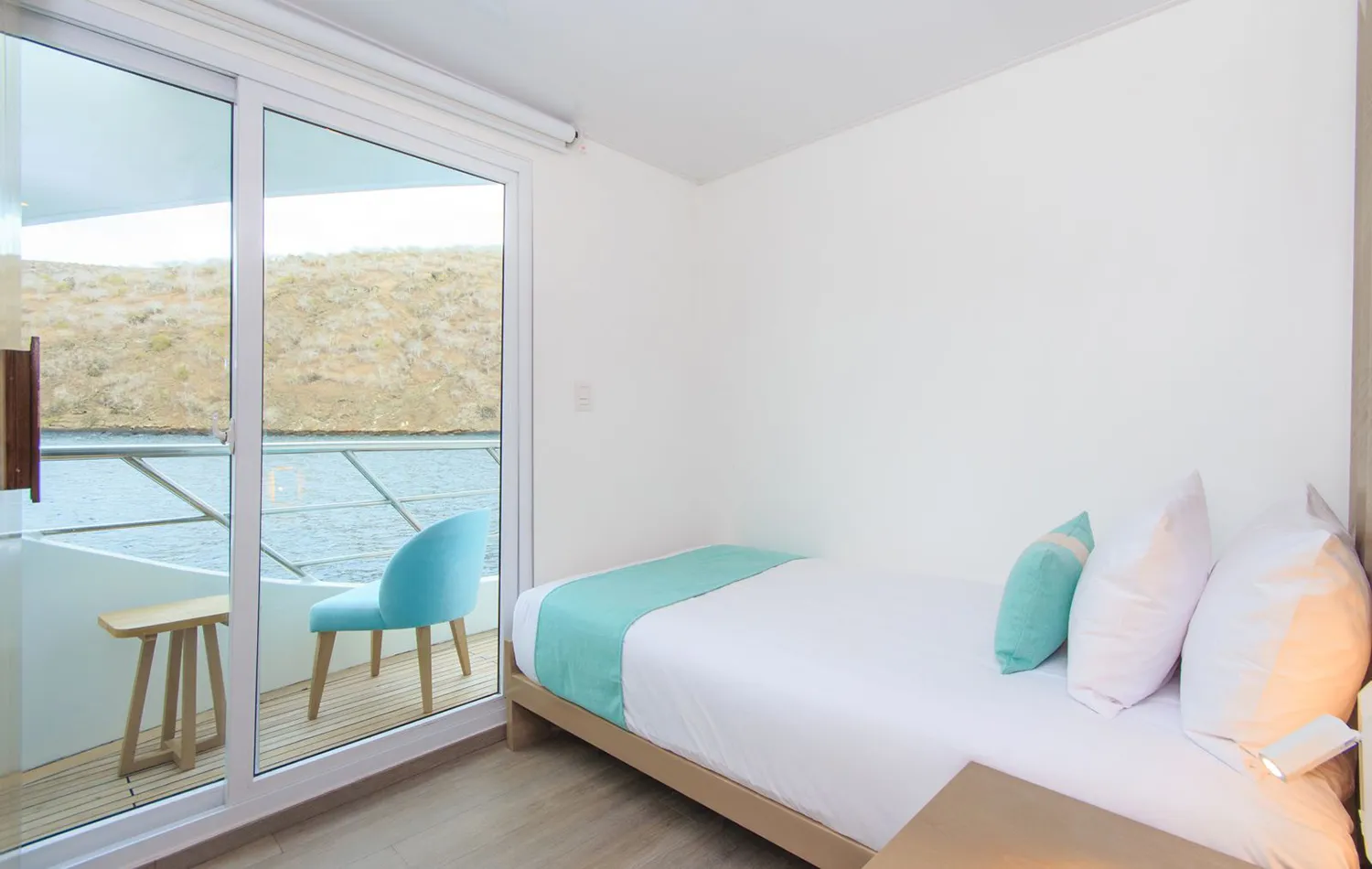
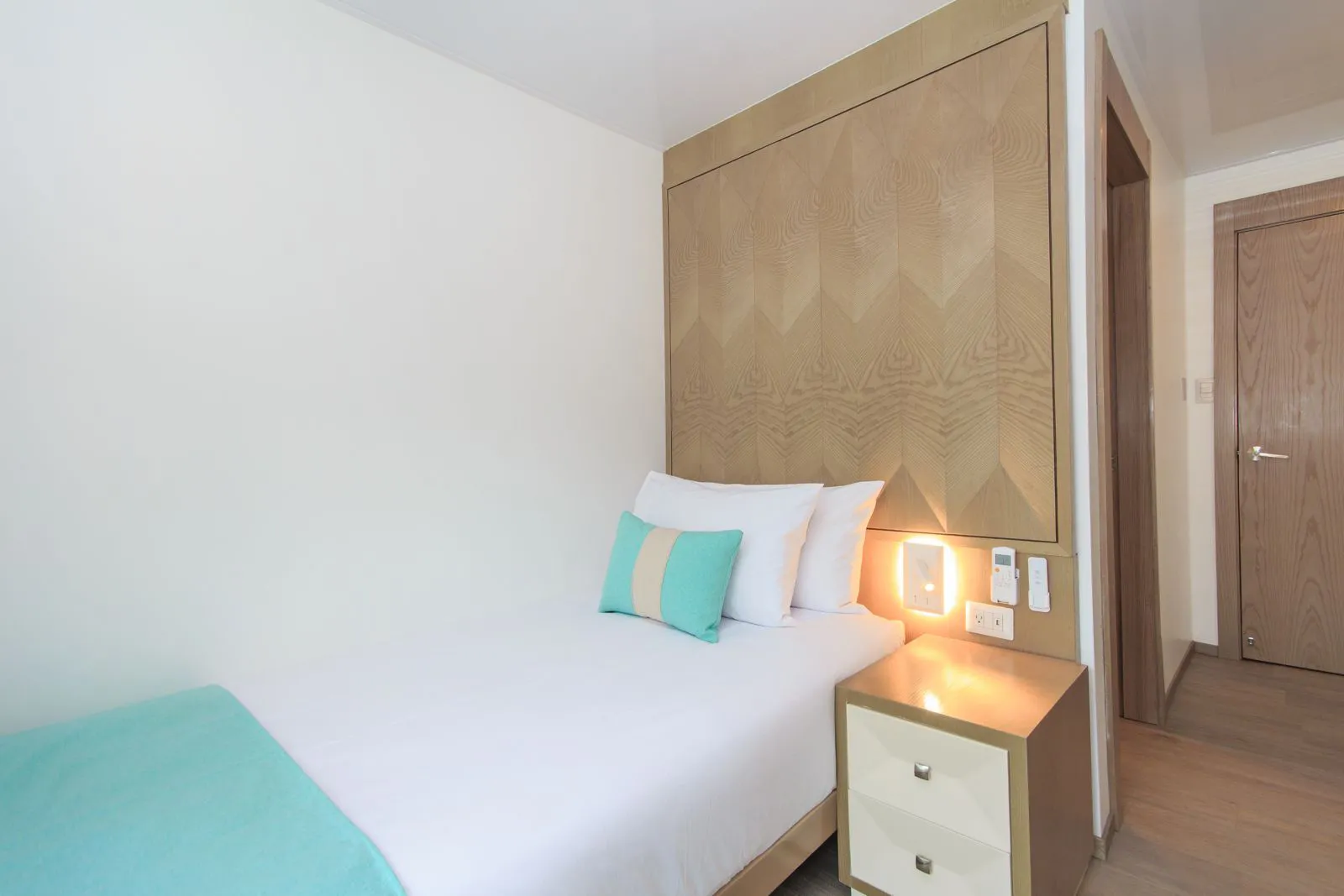
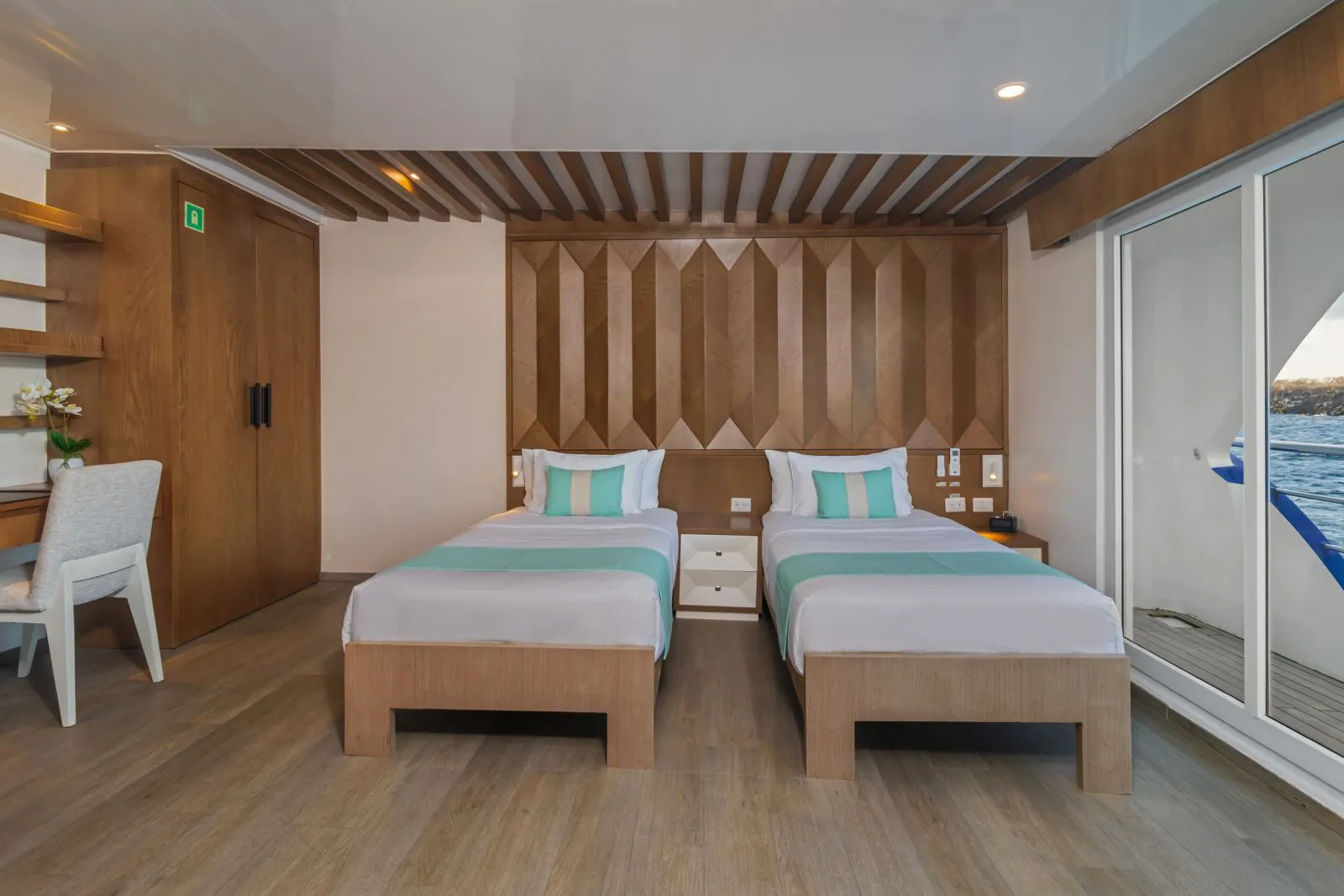
- Facilities: 9 double cabins with lower bed and A/C, private bathrooms with hot/cold water showers. Cruise Manager, DVD / TV, Jacuzzi, Kayaks, Private Balconies, Satellital Phone, Snorkeling equipment, WIFI, Library, Stand-up paddle, Wetsuit

Dates & Rates
To request a quote or make a reservation let's start with your details...*
What's Included
- Accommodation as confirmed.
- All mentioned meals (full-board); filtered water, tea and coffee.
- All guided excursions and activities as mentioned in the itinerary by a National Park certified naturalist guide.
- Beach towels and snorkelling gear (snorkel, mask, flippers; optional wet-suits for hire).
What's Not Included
- Round-trip flight to the Galapagos.
- Soft and alcoholic drinks.
- Galapagos National Park entrance fee ($200 subject to change) and Transit Control Card ($20 subject to change).
- Personal travel insurance.
- Personal expenses, extras and tipping.
Get in touch with us
Explore more of
Luxury Boats
Galapagos luxury boat cruises offer an unparalleled and exclusive way to explore this extraordinary archipelago. Travel in style and comfort aboard a high-end yacht or catamaran, featuring spacious cabins, gourmet dining, and top-notch amenities. Enjoy personalized service and expert naturalist guides who lead intimate excursions, providing deeper insights into the unique wildlife and geology. These cruises combine adventure with sophistication, ensuring a truly unforgettable and indulgent Galapagos experience.